
By Daily Carry Lab. Primary documentation checked October 13, 2026 (Pacific).
Affiliate disclosure: As an Amazon Associate, Daily Carry Lab earns from qualifying purchases. Retailer links may earn a commission at no extra cost to you. Manufacturer links here document sources.
Research disclosure: This guide uses primary documentation, not hands-on testing. Product figures are manufacturer ratings; no DCL score or benchmark is assigned.
A 30,000mAh headline is an incomplete way to choose a bank for a long trip. It omits the voltage behind the capacity figure, how much energy reaches your devices, and what the complete kit weighs. Before looking for the largest number, decide whether your trip involves flying and how long you actually go without a recharge opportunity.
This guide examines that energy-versus-carry tradeoff using NITECORE CARBO 20, a documented 20,000mAh-class example. It is deliberately not presented as a 30,000mAh product. A smaller documented bank can be a better question to investigate than an unverified larger listing; we have not established a universal winner or ranked the market by endurance.
Use watt-hours to make the first cut
FAA explains that battery Wh equals voltage multiplied by amp-hours. For mAh, divide by 1,000 first. Use the manufacturer’s marked battery rating and voltage, not the USB charging voltage. FAA energy calculation guidance.
For illustration, 30,000mAh at a stated cell basis of 3.7V gives 111Wh. That arithmetic describes a hypothetical rating, not a verified product or its usable USB energy. Changing the voltage basis changes the result. An advertisement that lists only mAh cannot by itself prove compliance with a Wh limit.
| CARBO 20 documented quantity | Manufacturer specification | Boundary |
|---|---|---|
| Cell energy | 76Wh rated / 77.6Wh typical, at 15.52V | Retain both labels; do not replace them with a generic 20K calculation |
| Carried bank mass | 320g ±5g | Add cables, supply and case to obtain kit mass |
| Body dimensions | 128 × 48 × 29mm | These do not establish packed clearance with plugs |
| Single USB-C output | Up to 65W from OUT1 or OUT2 | Exact device/profile negotiation remains necessary |
| Two-port total | 15W at 5V/3A | Two 65W ratings cannot be added |
| USB-C recharge input | Up to 65W | This is not a measured full-charge time |
Source: NITECORE CARBO 20 specifications. CARBO 20 and the older CARBO 20000 are different product identities. We select the former; this guide does not inherit the latter’s specifications.
Decide what the extra energy buys you
Write down the expected gap between outlets, the devices you will power and the portion of their battery you expect to replenish. A larger bank is useful only if its energy and output match that need. If outlets are available each evening, carrying more stored energy may solve a problem your trip does not have.
Do not divide the headline mAh by a phone’s mAh to promise a charge count. Device use while charging and conversion losses matter, and capacity figures may use different voltage bases. This guide makes no measured usable-capacity or runtime claim.
| Use case | Compatibility check | Drawback to consider |
|---|---|---|
| One device at a time | Device supports an offered USB-C profile within 65W | The highest rated mode is not guaranteed for every device |
| Two devices together | Their combined needs fit the 15W shared limit | More cell energy does not preserve single-port speed with both connected |
| Travel laptop | Exact charging profile and workload fit the bank | A65W ceiling does not replace every original laptop adapter |
| Longer ground journey | Replenishment plan and complete kit mass are acceptable | Additional bank capacity still occupies luggage and must be recharged |
For the smaller phone/tablet packing decision, use the travel bank guide. This article’s central question is whether extra energy earns its weight and transport constraints, rather than which small bank belongs in a phone kit.
Separate regulator limits from carrier permission
The FAA table lists 100Wh as the ordinary lithium-ion limit, with airline approval for up to two larger spare batteries in the 101–160Wh band. Power banks must be carried on, protected from damage and short circuit. It also explicitly warns of stricter carrier and international limits. FAA passenger battery table, checked October 13, 2026.
American Airlines’ current portable-charger rule limits each to 100Wh and two per passenger. Its onboard handling rules require accessibility/visibility and prohibit seat-outlet recharging and overhead-bin storage. AA restricted items, checked October 13, 2026. The broader FAA approval band is not permission to take a 111Wh bank on AA. Verify the actual operating carrier, itinerary and legible marking before buying for a flight.
Budget and selection limits
| Approach | Budget evidence on October 13, 2026 | Reason to consider | Drawback |
|---|---|---|---|
| CARBO 20 documented example | Current US price unknown; no numeric budget band retained | Its energy, mass and output are documented together | Shared 15W output may not meet a two-device plan |
| A claimed 30,000mAh bank | Exact model, voltage, Wh, mass and price unresolved | Ground-use energy need may justify investigating one | The label alone cannot establish air carriage or useful USB output |
| Smaller existing bank | New purchase cost avoided if suitable; accessory cost unknown | Recharge opportunities cover the energy gap | Less reserve for unplanned gaps; verify exact condition and profiles |
Choose after completing the energy, kit-weight and carrier checks. We have not tested CARBO 20, charge-through, waterproofing, thermal behavior, usable energy or endurance. No retailer identity, current stock or hands-on ranking is implied by this source-based example.
Compare stored energy with rated USB output energy
CARBO 20 now has a more useful planning figure than its cell-capacity headline alone. The manufacturer specification and rated-energy FAQ, checked October 21, list 13,500mAh at 5V, typical 3A, and identify 67.5Wh at 5V/3A as usable energy. This is NITECORE’s stated rating, not a DCL discharge measurement or a guaranteed result at a laptop’s higher-voltage profile.
| Quantity for this exact model | How to use it | What it cannot establish |
|---|---|---|
| 76Wh rated / 77.6Wh typical cell energy | Compare the battery’s documented stored-energy labels | Energy delivered to every device at its charging port |
| 67.5Wh rated USB energy at 5V/3A | A more relevant manufacturer reference for a matching USB load | The same delivered energy at 20V, in cold weather or with your cable |
| Your trip’s device-energy requirement | Estimate the actual replenishment needed between outlets | A charge count from dividing two mAh labels |
NITECORE says actual usable energy varies with consumption, cable quality, ambient temperature and usage. Compare a competing bank only when its output rating states comparable voltage and load conditions. If a competing bank supplies only a cell figure, the useful-energy comparison remains unresolved.
This changes the budget decision: first check whether the documented energy at the relevant output condition covers your expected gap between outlets, then weigh the complete kit. If the output conditions do not match your laptop, leave that estimate uncertain rather than buying extra capacity on a false charge-count promise. Current exact-model checkout totals remain unknown. The existing shared 15W limit and carrier-specific checks still apply; the 67.5Wh USB figure does not replace the battery’s marked stored-energy rating for transport decisions.
Plan charging stops and dry-port handling, not just reserve capacity
A larger energy reserve also has to fit the time and conditions available for recharging. The CARBO 20 manufacturer FAQ, checked October 24, 2026, says a USB-C charger rated at least 65W and a compatible fast-charging cable are required to reach the bank’s 65W recharge mode. It also says actual power varies with the charger, cable, protocol, battery level and ambient temperature. A 65W badge alone is not a fixed refill rate.
| Trip decision | Documented constraint | What to include in the plan |
|---|---|---|
| Recharge during a short stop | Input power varies with setup and state of charge | Match the supply, cable and available outlet time; full-charge time is unverified here |
| Expect peak input until full | The bank reduces charging power near full or as temperature increases | Do not divide stored Wh by peak watts to promise a refill time |
| Use after water exposure | Ports must be completely dry before charging or discharging | Plan a dry handling opportunity before connecting equipment |
| Choose by the waterproof headline | Manufacturer also says to avoid prolonged submersion | A rating does not authorize using wet connectors |
NITECORE describes the power reduction as part of its battery and thermal-management strategy. That means a lower reading near full does not, on its own, establish a failed supply or justify buying a higher-wattage charger. Check the exact setup and operating condition before spending on another accessory. This does not diagnose a damaged bank, and DCL has not measured charging curves or thermal performance.
The dry-port instruction is particularly relevant when deciding whether reserve power will be accessible during a wet outing. Keep the power bank and device connection suitable for the conditions; do not read the product’s waterproof description as permission to connect it while its ports are wet. We have not tested immersion, a drying time or safe operation in a particular weather condition.
Budget and drawback: price the missing compatible charger and cable along with the bank, rather than budgeting from the battery alone. Actual delivered totals remain unknown. A larger bank may reduce the number of charging stops you plan, but it cannot remove the need for a suitable outlet, adequate time and appropriate handling. The earlier carrier and shared-output limits still govern their separate decisions.
Compare a smaller bank before buying more reserve
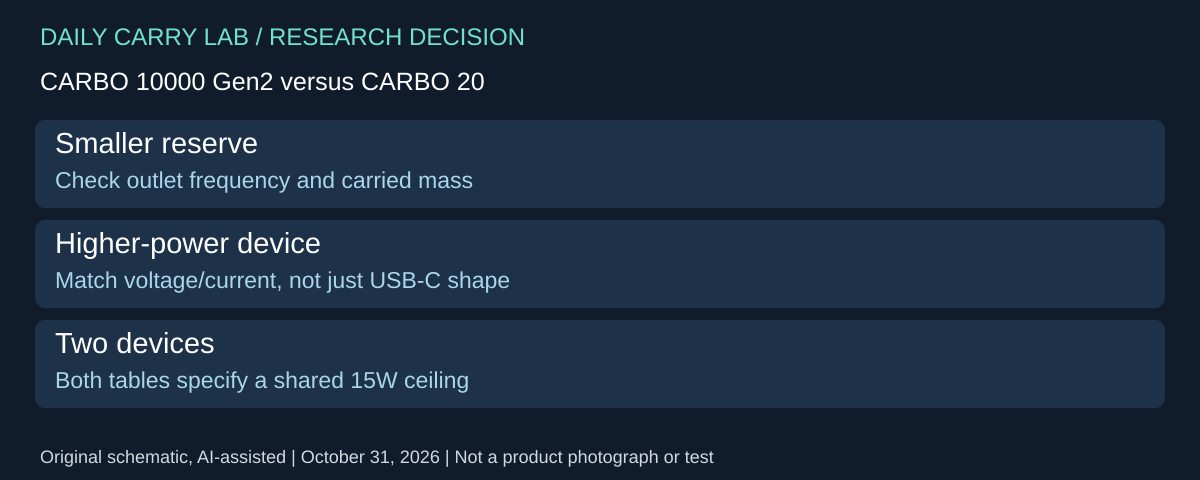
A lighter bank can be the better purchase when daily outlets cover the energy gap. NITECORE’s CARBO 10000 Gen2 specifications, checked October 31, 2026, add a concrete smaller alternative to the CARBO 20 example above. These are different models; do not substitute the earlier CARBO 10000 generation.
| Documented quantity | CARBO 10000 Gen2 | CARBO 20 |
|---|---|---|
| Stored energy | 38.8Wh | 76Wh rated / 77.6Wh typical |
| Product mass | 170g ±5g | 320g ±5g |
| Single-port output ceiling | 30W | 65W |
| Two-device total | 15W | 15W |
The nominal mass difference is 150g before cables and supplies. The smaller model’s listed output profiles stop at 15V/2A; they do not establish the CARBO 20’s 20V/3.25A path. Check the device’s required profile before trading reserve for lower mass. CARBO 20 reference.
Selection and budget: consider Gen2 for a compatible lower-power kit with frequent outlets; retain the higher-power candidate when its documented profile is required. Neither table predicts usable laptop charge counts. Current complete-kit totals and retailer packages are unknown; no new purchase link or endurance test is claimed.
Sources and limits
This guide compares published specifications and source documentation. Daily Carry Lab has not performed hands-on tests of the products in this guide. Consult the dated sources and verify the exact model and current terms before buying.
Related guides
Is Anker Prime worth it? Power-bank specs, ports and tradeoffs
Assess Anker Prime A110B and A110A by single-port power, total output, recharging requirements and carry weight.
Handheld gaming power banks: match the USB-C profile before capacity
Compare Steam Deck OLED, original ROG Ally and Ally X RC72LA power paths, Anker output profiles, and the limits of runtime estimates.
Anker vs UGREEN power banks: compare exact models and support
Compare documented A1336 and UGREEN 90597A limits, note missing shared-power evidence, and check seller-specific warranty terms without a universal brand ranking.
Magnetic iPhone battery packs: Qi2 25W, phone compatibility and shared power
Compare Anker A1664, MagGo 2 Pro A110R and Belkin BPD004 by phone support, wireless ceilings, shared output and case limits. Manufacturer research.