By Daily Carry Lab. Primary documentation checked October 13, 2026 (Pacific).
Affiliate disclosure: As an Amazon Associate, Daily Carry Lab earns from qualifying purchases. Retailer links may earn a commission at no extra cost to you. The manufacturer links here are evidence sources.
Research disclosure: This is a primary-documentation guide, not hands-on testing. Specifications and battery figures come from manufacturers. We assign no DCL rating, fit-test result or performance score.
A phone-charging solar kit is useful only when you can expose the panel to enough sunlight and carry the rest of the charging chain. Before choosing a panel, decide whether you need power while walking, during a stationary break, or after sunset. A panel’s rated wattage is not stored energy, and it cannot promise phone charging when sunlight is unavailable.
This guide starts with the NITECORE FSP30 as a documented folding-panel candidate and adds an integrated-battery alternative below, rather than inventing a ranking. It addresses the whole off-grid phone kit: deployed space, carried mass, cable, optional battery buffer and restart uncertainty. The companion USB solar output guide covers port allocation and the misleading assumption that a large panel rating is USB laptop charging power.
Check the size of the job before the product
| Your actual need | Kit to consider | Main drawback |
|---|---|---|
| A short trip within your charged battery’s capacity | Charge your phone and owned bank before leaving | No solar replenishment if the trip extends |
| Stationary daylight breaks with room to deploy | A documented folding USB panel plus the phone’s cable | Shade, changing angle and clouds can interrupt the source |
| Phone power after sunset | A compatible charged battery bank, replenished separately when possible | Extra carried mass and a separate charging/storage step |
| A guaranteed time-critical reserve | Establish a known charged reserve before departure | Unmeasured solar output cannot establish guaranteed reserve |
These are planning choices, not DCL field results. Estimate your phone’s actual use and the energy you already carry. Do not infer phone refill count from the panel’s watts: watts describe a rate under conditions, while the energy stored in a battery is a different quantity. If the already-owned bank covers the planned trip, a panel may add complexity without solving a need.
The documented FSP30 candidate
| Manufacturer specification | FSP30 | What it means for packing |
|---|---|---|
| Folded dimensions | 295×170×45mm | Measure the bag’s usable opening and thickness allowance |
| Unfolded dimensions | 295×880×4mm | A long deployed surface needs unobstructed sun and space |
| Panel weight | 625g ±5g | Add your bank, cable and any protection separately |
| Total maximum output | 30W | A panel ceiling, not a promised phone input |
| USB-C profiles | 5V/3A or 9V/2A; maker describes up to18W PD | Phone/cable negotiation and sunlight still matter |
| USB-A ports | Two; maker lists total5V/3.1A | Do not treat each socket as an independent full output |
Source: NITECORE FSP30 specifications. The maker’s 24% cell-efficiency claim is not whole-kit phone-charging efficiency. No full-charge time, cloudy-weather rate or comparative output test is established here. We did not reproduce the advertised maximum in the field.
The dimensions make this a deployment decision as much as a pocket-size decision. A panel packed inside a bag is not exposed to useful sunlight. Find a placement that fits your stop and avoids covering the cells, pulling on the cable or putting the phone under the hot panel. Do not assume that attaching it to a moving bag delivers the stated maximum. Confirm the phone’s temperature and charging guidance for the actual environment.
Decide whether to add a battery buffer
A separate bank can store energy for use later, but its own input must match the panel output. Check whether the bank accepts the documented USB-C profile, what cable it needs and whether it has enough capacity for your intended reserve. Charging the bank first and the phone later is a different arrangement from powering both through it simultaneously.
Do not assume a bank supports charge-through, and do not assume it isolates the phone from every interruption. Look up that exact bank’s manual if simultaneous input/output is part of the plan. The travel power-bank guide can help with capacity and charging choices; it does not establish compatibility with every solar source.
No automatic shade-restart behavior was established from the FSP30 primary page captured for this guide. If charging stops after a cloud or shadow, be prepared to check the device and reconnect only as its instructions allow. Do not base an unattended charging plan on a feature we have not verified. Similarly, no ingress rating or waterproof guarantee is established from that captured page; protect the electronics and follow the maker’s instructions rather than inferring weather resistance from an outdoor photograph.
Budget and a useful pre-trip check
| Kit choice | Exact price evidence, October 13, 2026 | Additional cost or uncertainty |
|---|---|---|
| Owned phone and charged compatible bank | No new panel purchase if sufficient | Existing bank capacity and condition still need checking |
| FSP30 plus phone cable | Delivered checkout price not established | A suitable cable and a place to deploy |
| FSP30 plus separate bank and cable | Complete-kit price not established | Bank input compatibility, extra weight and storage step |
We establish no cheapest panel or price ceiling. Compare the cost of the whole working kit, not only the panel listing. Before relying on it, try your exact panel/cable/device combination during an ordinary daylight stop and inspect what happens after temporary shade. That is a recommended buyer check, not testing DCL has performed. Retain a known charged reserve for needs the unmeasured solar setup cannot guarantee.
A different kit: a panel with its own battery
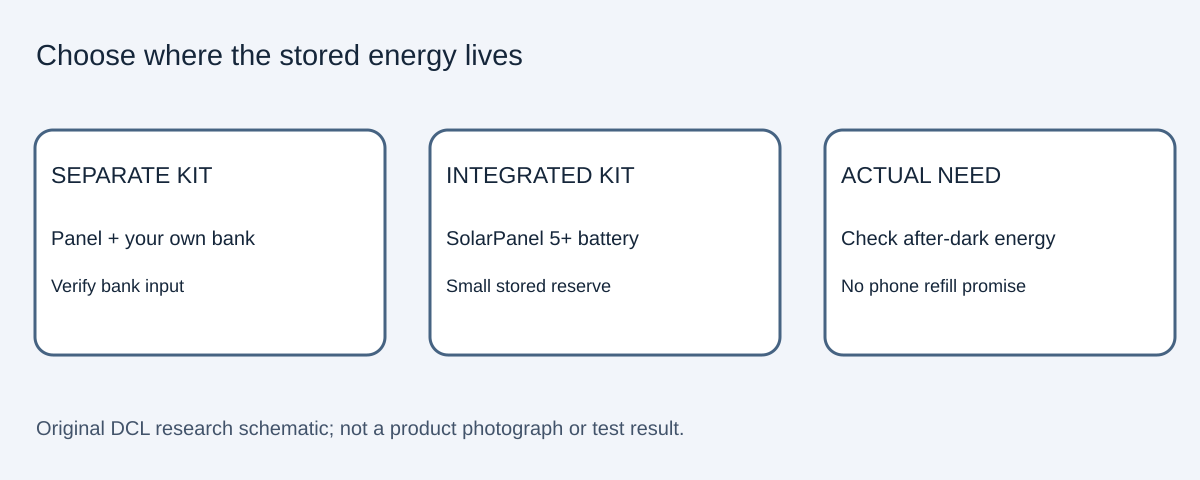
Added research checked October 31, 2026. BioLite SolarPanel 5+ offers an alternative to a separate panel and bank: its listed 3,200mAh onboard battery stores energy for later. The maker lists 5W, 390g, 257 × 208 × 24mm, Micro USB input and USB output.
| Kit choice | Reason to consider | Drawback |
|---|---|---|
| FSP30 plus separate bank | Choose a reserve around your needs | Add bank and cable mass |
| SolarPanel 5+ | Integrated storage | Fixed small reserve and Micro USB recharge input |
| Owned charged bank | Avoid solar deployment | No daylight replenishment alone |
The listed SolarPanel 5+ package includes a USB cord and instructions; confirm the cord ends against your phone. Its page has inconsistent watt-hour and generic feature text, so we exclude those fields, wireless charging and refill-count promises.
Choose by storage needs, not a measured efficiency ranking. Complete-kit costs remain unknown. Keep a known charged reserve when uncertain daylight harvest is inadequate. DCL has not tested either setup, restart, battery serviceability or weather exposure.
Check care and deployment limits before replacing an FSP30
Research checked November 3, 2026. The NITECORE FSP30 current manufacturer-hosted manual, English safety instructions and Q&A on its first PDF page, adds practical limits to the specification-only evidence above. It is a 2022 manual retrieved today, not a new 2026 product revision or performance test.
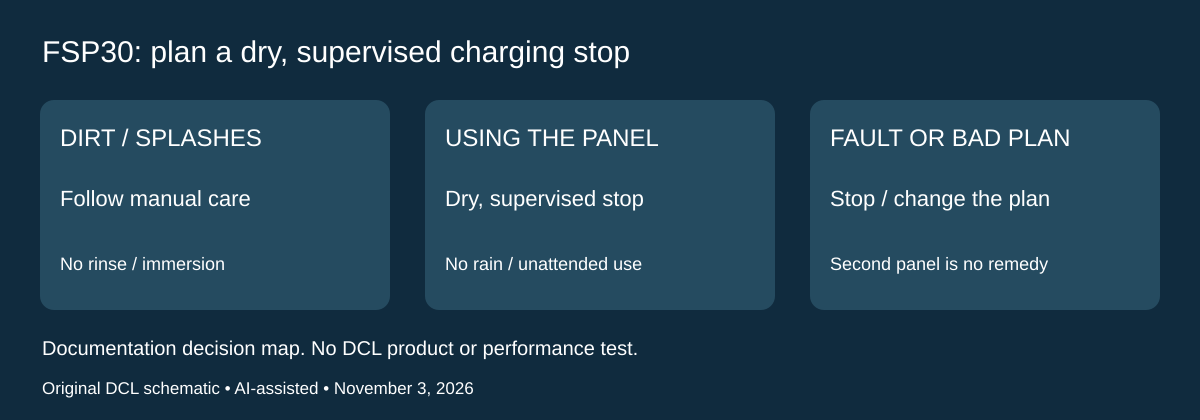
Dust or dirt may reduce performance, according to the manual. Its cleaning sequence uses a soft brush followed by a damp cloth. It prohibits immersing or rinsing the panel. If an owned panel appears to deliver less useful charging, inspect its surface and follow those instructions before deciding to buy another panel. Cleaning is a sensible check, not proof that it will restore the advertised maximum or fix an electrical fault.
| Planned use or condition | Exact FSP30 instruction | Carry decision |
|---|---|---|
| Dust or dirt on the panel | Soft brush, then damp cloth | Make cleaning part of care; do not hose it down |
| Rain or a moist environment | Do not expose it | Plan a suitable dry charging stop |
| Charging while you leave the kit | Do not leave it unattended in use | Choose a reserve charged beforehand if you cannot supervise |
| A sign of malfunction | Stop using it | Seek assessment rather than adding another load |
| Packing the panel | Do not bend or puncture it | Use the designed folding arrangement without bending individual panels |
The manual describes limited splash resistance and wiping accidental splashes with a soft cloth. That is not permission to leave the panel in rain, nor a waterproof rating for the phone or bank attached to it. Its prohibition on unattended use also changes the earlier buffer-bank idea: a separate bank does not make an unattended harvesting plan acceptable for this panel.
For a dry, supervised stop, retain the exact device-input and cable checks already listed. For a trip that requires wet-weather harvesting or leaving a working panel alone, remove FSP30 from that planned use instead of relying on outdoor marketing. Buying a second unit would not remove those documented limits. An owned charged bank can avoid that deployment step when its stored reserve is sufficient; neither its reserve nor a solar refill is guaranteed here.
We have not established an exact shared-port priority sequence, automatic shade restart, repair outcome or battery serviceability for SolarPanel 5+. Those remain separate questions. Current cleaning supplies, service and replacement costs are unknown, and DCL has not performed a cleaning, rain, charging or fault-diagnosis test.
Sources and limits
This guide compares published specifications and source documentation. Daily Carry Lab has not performed hands-on tests of the products in this guide. Consult the dated sources and verify the exact model and current terms before buying.
Related guides
Rechargeable headlamps: choose modes and a spare-power plan
Compare removable-cell headlamps with NU25 MCT UL built-in battery, light colors and complete charging kit. Manufacturer research, not testing.
USB solar-panel output: shared watts, PD profiles and laptop limits
Read the USB ports separately from solar-panel wattage using exact Anker625 and NITECORE FSP30 documentation.
iPhone 18 Pro: Wrist Strap or Crossbody Strap, with the right case
Compare exact Apple Wrist and Crossbody strap packages for iPhone 18 Pro by attachment, length, complete cost and limitations.
iPhone Duo cases: Apple Case versus Folio with Kickstand
Compare exact Apple iPhone Duo Case and Folio parts by coverage, viewing support, charging arrangements, separate equipment and dated US prices.