
By Daily Carry Lab. Primary documentation checked October 13, 2026 (Pacific).
October 28, 2026 research update: CORE recharge timing depends on the charging arrangement; the complete charger requirements and short-stop decision below supplement the earlier battery plan. Earlier source checks retain their stated dates.
Affiliate disclosure: As an Amazon Associate, Daily Carry Lab earns from qualifying purchases. Retailer links may earn a commission at no extra cost to you. Manufacturer links here document sources.
Research disclosure: This guide uses primary documentation, not hands-on testing. Product figures are manufacturer ratings; no DCL score or benchmark is assigned.
For hands-free walking and camp tasks, choose the lighting mode and backup plan together. The highest lumen number does not establish how long a beam remains useful on your route. Decide what you need to see, how long you expect to use the lamp and where its battery can be replenished.
We selected the current Petzl ACTIK CORE E065AB revision as a documented example because it provides separate rechargeable and AAA performance tables, a tilting plate and a current technical notice. The black variant is E065AB00; the manufacturer’s reference table also identifies other colors. The ACTIK CORE checklist below is supplemented by the October 29 SWIFT RL comparison; this is not an exhaustive hiking-headlamp ranking or a field test. Older ACTIK CORE revisions must not inherit these figures.
Compare useful modes, not just peak output
| Current ACTIK CORE with CORE battery | Manufacturer brightness | Listed burn time | Buying consequence |
|---|---|---|---|
| MAX BURN TIME | 7lm | 100h | Low-output mode; not evidence of suitable light for every walking route |
| STANDARD | 100lm | 7h | Compare this operating level with the activity you actually plan |
| MAX POWER | 625lm | 2h | Highest output does not mean constant 625lm for two hours |
Petzl ACTIK CORE lighting table, checked October 13, 2026. Figures follow the manufacturer’s ANSI/PLATO FL1 presentation; DCL has not measured output or runtime.
Petzl explains that FL1 burn time runs until output falls to 10% of maximum, rather than showing that initial brightness is sustained for the entire period. Reserve lighting is a separate measure. Its guidance warns that reserve may be inadequate for faster activities. Petzl’s FL1 explanation.
Do not infer trail visibility from lumen or distance maxima alone. The beam, terrain, your pace and conditions belong in the decision. If you cannot establish that a mode suits the activity, get appropriate activity-specific guidance and validate the setup before relying on it away from easy assistance.
Decide how you will carry and aim it
| Fit or function | Documented ACTIK CORE feature | Limit |
|---|---|---|
| Worn mass | Listed 88g | Manufacturer figure; no DCL complete-kit weighing |
| Beam | Wide or mixed | No DCL beam-pattern or route-visibility test |
| Aim | Plate tilts up/down | Tilt range and worn comfort not measured here |
| Storage | LOCK function | Follow the newer notice’s battery-disconnection recommendation for carrying |
Source: Petzl current model documentation. A headlamp frees a hand for camp tasks in a way a pocket light does not; it also introduces headband fit and aiming decisions. The separate pocket flashlight guide addresses carried lights, replaceable cells and lockout without claiming these are interchangeable choices.
Make the spare-power plan explicit
The lamp comes with a CORE battery and also accepts three AAA/LR03 cells. With AAA cells its listed MAX POWER changes to 450lm; do not apply the625lm rechargeable table to that setup. Petzl energy and AAA table.
| Power plan | Compatibility requirement | Drawback |
|---|---|---|
| Recharge CORE | USB-C cable; charger output no more than 5V; comply with all notice requirements | Cable not included; charging needs time and a suitable source |
| Carry spare CORE | Use the named compatible rechargeable battery | Extra cost/mass; recharge and storage plan still needed |
| Carry AAA alternative | Three compatible AAA/LR03 cells; correct polarity and matching cells | Performance differs from CORE; no mixed old/new cells or brands |
The current technical notice E0161700C dated April 28, 2026 gives approximately 3h30min charging, requires dry connectors and says to remain with the battery while charging. It warns that nearly depleted CORE may switch off abruptly. It recommends disconnecting the battery for carrying to prevent accidental activation. Read and follow the full notice, including charger specifications, rather than relying solely on this table. Petzl instructions.
Budget and drawbacks
| Approach | Budget evidence on October 13, 2026 | Reason to consider | Drawback |
|---|---|---|---|
| ACTIK CORE documented revision | Current exact-variant checkout price not retained; no budget ceiling | Rechargeable/AAA choices have separate documented tables | Backup cells, cable and power source add to the kit |
| Keep an existing headlamp | New lamp cost avoided if suitable; battery/cable cost unknown | Its exact manual and condition support your activity | A similar name does not establish this revision’s modes or charging |
| Separate pocket light | Exact model/price require separate selection | A carried light meets a different access task | It does not establish hands-free worn fit |
We have not tested comfort, beam shape, sustained output, waterproofing or charging. No star score, retailer variant, stock claim or real-world endurance promise is assigned. Choose with an explicit operating mode, suitable backup and the exact revision’s instructions.
A stored headlamp needs a readiness plan
The ACTIK/ACTIK CORE notice E0161700C, English sections C–D, checked October 21, distinguishes damp-use drying from long-term storage.
| Situation | Documented instruction | Planning consequence |
|---|---|---|
| Put CORE away for months | Charge it, repeat every six months, and remove it from the lamp | A second battery adds maintenance, not permanent readiness |
| Store the kit | Keep batteries dry and protected from impacts; ideal storage is 20–25°C | Check where the spare will live between trips |
| Return from damp use | Remove the battery; air-dry it and the open lamp | Allow drying time before repacking |
Petzl says batteries will be discharged after twelve months unused under its stated storage conditions. Do not treat an unopened bag as proof of a charged reserve. These are manufacturer instructions, not measured discharge results.
Choose the rechargeable plan if you can maintain that schedule; include any spare and suitable storage in your budget. Current totals remain unknown. Recheck your actual kit before departure; DCL has not tested stored-battery readiness.
A spare battery does not cover every loss-of-light problem
For an outing that extends beyond an easy return, separate replacement energy from another usable light. The current ACTIK/ACTIK CORE technical notice E0161700C, checked October 24, 2026, describes blinking five minutes before reserve lighting and again on entering reserve. Petzl describes reserve as enough for walking, with insufficient output for dynamic activities such as running, mountain biking or skiing. It separately warns that a nearly depleted CORE battery may shut off abruptly.
| Problem the kit must address | What the existing spare plan can offer | What still needs a decision |
|---|---|---|
| Depleted compatible battery | Replace CORE or use the documented AAA arrangement | Know how and where you can make the change |
| Lamp enters reserve during a faster activity | Recognize the documented warning and reduced-light boundary | Do not budget reserve as normal activity lighting |
| Lamp is lost, damaged or fails to work | A spare battery alone does not replace the lamp body | Evaluate whether a separate suitable light belongs in the kit |
| Battery change when surroundings are dark | An accessible second light may illuminate the task | Confirm its condition, access and suitability yourself |
The final two rows are packing inferences, rather than Petzl performance claims or a DCL-tested emergency system. They change what to compare at checkout: another CORE battery and another lamp are different purchases, and neither guarantees coverage of every failure. The existing flashlight guide addresses a separate light selection; we have not verified any particular two-light combination.
Do not extend the rated burn-time calculation by assuming a dependable interval after the reserve blink. The notice gives a warning sequence and an activity restriction, while CORE’s abrupt-shutoff qualification remains. The earlier FL1 explanation also prevents treating nominal burn time as constant initial brightness.
Budget and selection: list the primary lamp, compatible replacement energy and any separate light before comparing total carried cost. Current totals and complete-kit mass are unknown. If your existing equipment already supports the intended activity and backup arrangement, buying a new maximum-lumen figure may leave the same practical gap. Familiarize yourself with the actual equipment before departure. We have not tested reserve duration, battery changes in darkness, route visibility or failure recovery.
Check the headlamp alongside the other equipment you must carry
A headlamp can free a hand without replacing the other equipment needed for an activity. The current ACTIK/ACTIK CORE notice says its reflective headband is not high-visibility personal protective equipment, and Petzl lights do not substitute for required standardized lights where traffic regulations apply. A higher lumen setting does not change those classifications. Technical notice E0161700C, English section B, checked October 25, 2026.
| Intended use | Extra compatibility decision | Limit for the purchase |
|---|---|---|
| Walk or work near regulated traffic | Identify the required visibility equipment and lights separately | Reflective headband and bright beam do not establish compliance |
| Carry sensitive electronic equipment | Follow both devices’ interference instructions | Electromagnetic compliance does not guarantee no interference |
| Use with an avalanche beacon | The notice gives 50cm minimum separation in its beacon example | This is not a universal safe distance for every device or situation |
| Share space with other people | Adjust beam level and tilt to limit dazzling | Maximum output is not automatically the useful operating mode |
Petzl says that if interference is noticed between the lamp and electrical equipment, turn off the lamp or keep it away from sensitive equipment. Its examples include avalanche beacons, flight controls, communications equipment and medical devices. We have not tested any such pairing, and the notice’s beacon example must not be treated as approval for every electronic device at that distance. Obtain the relevant equipment instructions before relying on a combined arrangement.
This changes the complete-kit comparison: allow for required visibility equipment and a workable placement for other electronics before deciding the lamp alone solves the task. Current total cost is unknown. Keeping a suitable existing headlamp may be reasonable if the full arrangement meets the activity’s requirements; a replacement with more advertised lumens does not settle interference or traffic-equipment questions. This section does not establish legal compliance for a particular route or approve use with a particular sensitive device.
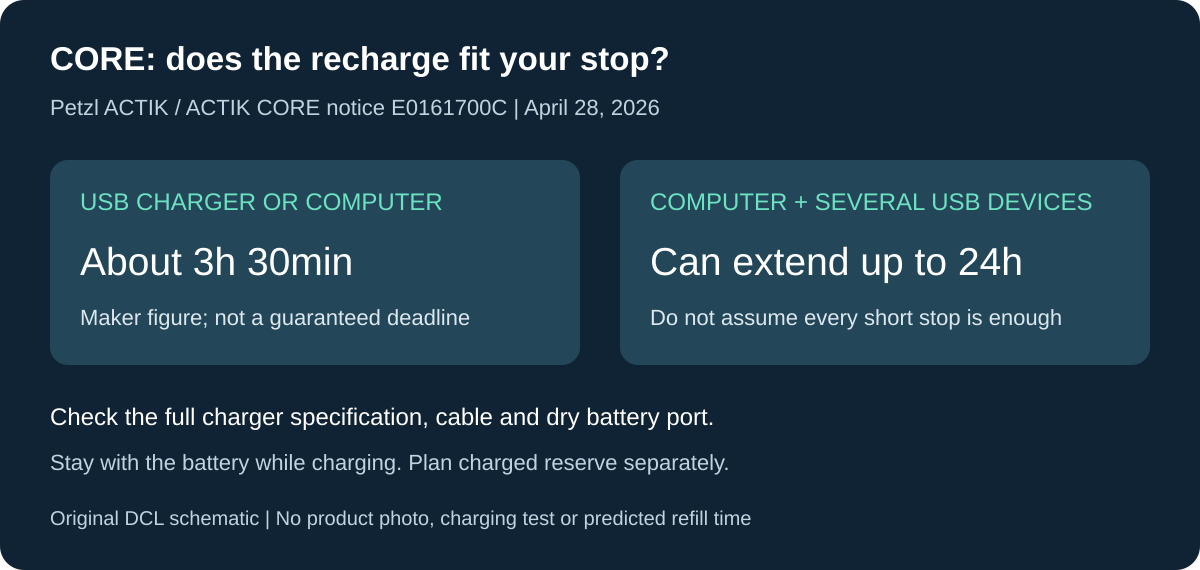
Original DCL research diagram, October 28, 2026. Manufacturer planning figures; actual recharge time is untested. See the full charger requirements below.
Match CORE recharge time to the stop you actually have
A recharge plan that works at home may fail to fit a short stop. For ACTIK CORE with the documented CORE battery, Petzl lists about 3 hours 30 minutes on a USB charger or computer, then qualifies computer charging: several connected USB devices can extend that time up to 24 hours. These are manufacturer planning figures, not DCL measurements or a promised completion time for your setup. ACTIK/ACTIK CORE notice E0161700C (280426), page 3, Charging time, checked October 28, 2026.
| Available opportunity | Decision before choosing CORE as the only reserve | Drawback to budget for |
|---|---|---|
| A brief stop before using the lamp again | Do not assume an empty CORE becomes a full spare during that stop | Carry a charged compatible reserve or another suitable working light |
| A computer charging other USB devices | Allow for Petzl’s extended-time qualification | Laptop port access alone does not establish a ready battery at departure |
| A dedicated wall-charging stop | Match the actual charger to the complete requirements below | USB-C connector shape and headline wattage are insufficient selection evidence |
| No dependable recharge opportunity | Compare the existing compatible AAA or charged-CORE plan | Include the extra energy and maintenance in the complete kit |
The notice requires a USB-C charging cable, which is not included. For an electrical charger it specifies output no greater than 5V and Class II double insulation with CE/UL approval. If connected to a high-power source that can create power surges, the notice says a surge-protected charger is necessary, specifying IEC 61000-4-5 and CE marking. It also requires a dry battery port and attendance while charging. These conditions add to the earlier 5V reminder; a high-wattage laptop charger is not established as suitable simply because its cable fits. Check the exact charger documentation or obtain Petzl’s confirmation for an unresolved setup.
Our buying inference is to assess the charging opportunity before paying for a second rechargeable battery. A spare that is already charged and a second battery still awaiting charge solve different problems. If your itinerary cannot accommodate the documented process, extra battery capacity or another advertised lumen maximum does not create more time at the outlet. The earlier separate-light and AAA compatibility boundaries remain applicable; we have not tested any combined backup system.
Budget and selection: price the exact battery, cable and qualifying supply you still need. Current delivered totals are unknown. Keep an existing suitable charger only when its documentation meets the requirements; buying a new supply by wattage alone does not settle them. DCL has not measured recharge speed, verified a particular third-party charger, or established unattended or guaranteed overnight charging.
ACTIK CORE or SWIFT RL: choose the control and battery system
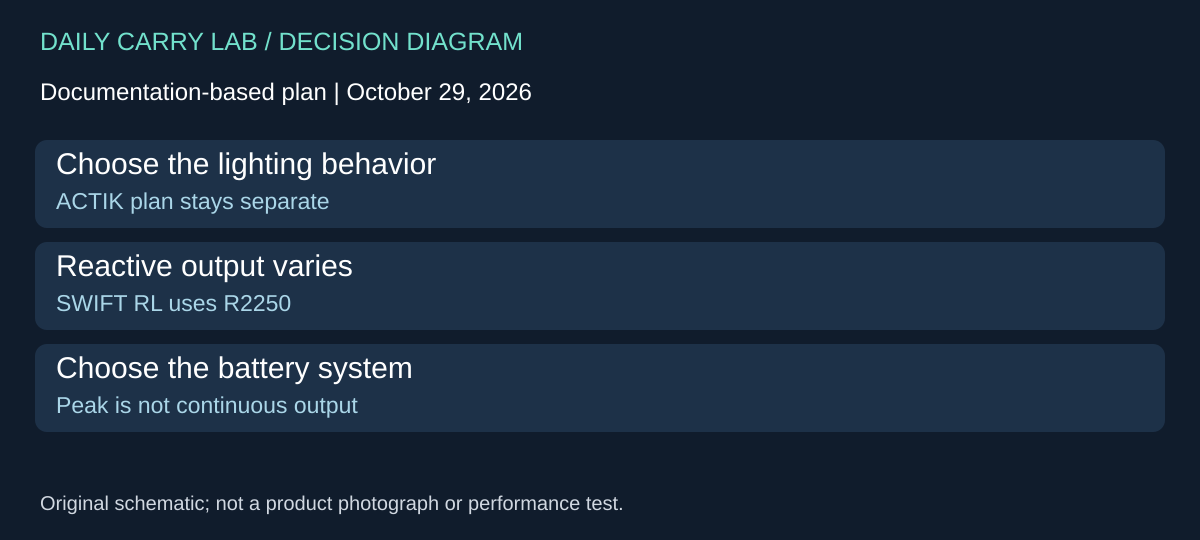
A sensor-controlled headlamp changes more than the maximum-lumen number. Consider the current Sport SWIFT RL, BLACK/ORANGE E095BC00, if automatic adjustment matters; retain the ACTIK CORE plan above when its documented modes and spare-power arrangement already fit. The current SWIFT RL page identifies 1200 lumens, 92g and an R2250 rechargeable battery. This comparison excludes older or professional SWIFT RL revisions. Current Petzl product and reference, checked October 29, 2026.
| Buyer requirement | Current SWIFT RL evidence | Consequence for the choice |
|---|---|---|
| Automatic adaptation | REACTIVE LIGHTING responds to ambient light; STANDARD is also available | Choose the operating method as well as output |
| Predictable manual behavior | The notice says reactive brightness and burn time vary with use and environment | A headline runtime is insufficient for your route plan |
| Maximum brightness briefly | Product describes a six-second BOOST | Do not budget the peak as continuous illumination |
| Spare energy carried separately | Notice permits only Petzl R2250 rechargeable battery | The ACTIK CORE/AAA plan does not transfer |
| USB-C recharging | R2250 uses USB-C; charging cable excluded on the product page | Include a suitable cable in the kit |
In REACTIVE mode, sufficient ambient light causes dim blinking for two minutes followed by automatic shutoff, according to the linked SWIFT RL technical notice, English page 3. Decide whether that control behavior fits the way you intend to move between light and dark areas. It is not evidence that the lamp will maintain a chosen fixed brightness throughout changing conditions.
Before paying for this upgrade, identify the unmet requirement in your existing lamp: adjustment effort, a documented mode, or the energy system you can support. A higher peak by itself does not establish a better match for a long outing. Follow the notice to learn switching and lock behavior before relying on the lamp; do not infer that either model replaces independent backup lighting.
Budget and drawback: exact delivered prices, replacement-battery cost and a verified US retailer package are unknown. The R2250 requirement creates a different spare-parts plan from the ACTIK system. Account for the selected battery, cable and charging opportunities before deciding that replacing an adequate lamp reduces what you carry. We have not compared beam quality, real burn time, fit or sensor response in the field. Petzl’s activity descriptions do not establish that this guide has approved your particular route, weather or safety plan.
NU25 MCT UL: choose lower carry weight or a removable battery
October 30, 2026 research addition: the NITECORE NU25 MCT UL adds a different battery and headband choice to this guide. Select it for a light kit and selectable light color when a built-in battery fits the trip. Keep the existing removable-battery options in consideration when replacing a depleted cell away from USB power is essential. No DCL beam, runtime or comfort test establishes a winner.
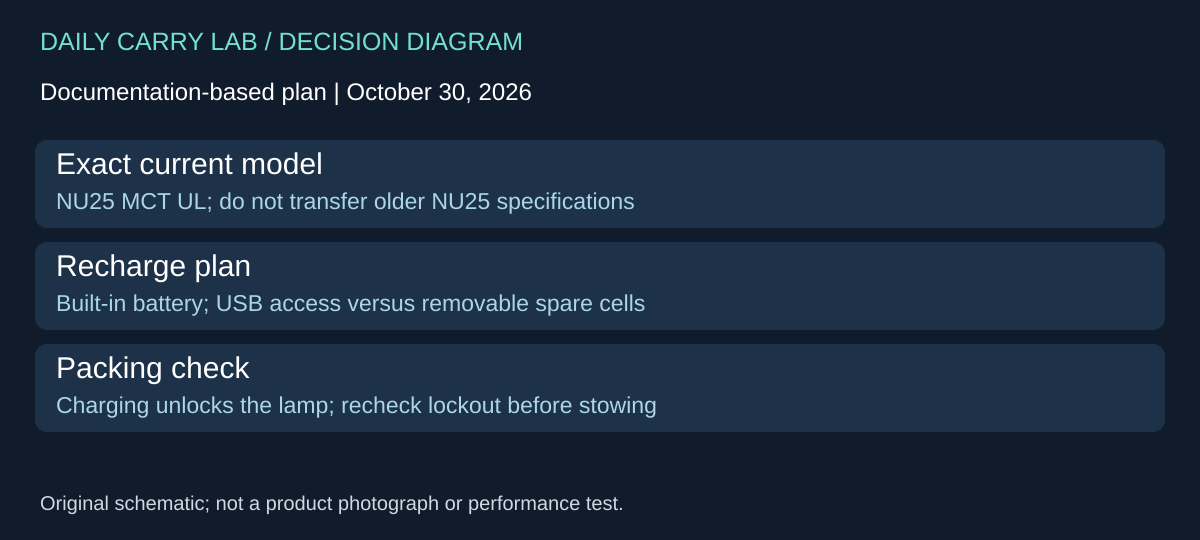
The current NITECORE product page identifies the model as NU25 MCT UL, although the URL ends in nu25ul. That short URL is not evidence that an older NU25 UL has the same battery, beam or controls. The linked NU25 MCT / MCT UL manual separates the two current variants: MCT UL is listed at 47g including bracket and headband; MCT at 50g on the same basis. Choose by the full model name on the package.
| Decision | Documented MCT UL arrangement | Consequence to accept |
|---|---|---|
| Carry the complete lamp on your head | 47g with bracket and headband | Charger, cable and backup light add to the trip kit |
| Change light color without another lamp | Warm 3,000K, neutral 4,500K and cool 6,500K primary light; auxiliary red | No tested fog penetration, visibility or comfort advantage established |
| Restore depleted battery energy | Built-in 700mAh lithium-ion; USB-C charging | The documented recharge path is external USB power, rather than an AAA/CORE swap |
| Recharge at a stop | Manual quotes approximately 1 hour 15 minutes at 5V/0.5A | This is a maker estimate; stop duration and actual charging conditions still matter |
Do not combine the page’s 400-lumen maximum with its 45-hour maximum-runtime headline as one operating point. This comparison does not select a runtime from that headline or promise constant output. Use the manual’s mode table for the brightness you require; we have not measured its discharge curve. The fixed battery makes charging access part of the purchase decision even when the lamp itself weighs little.
For packing, the manual describes a two-button lockout, and says charging automatically unlocks it. After topping up, check the lock state again before putting the light into a pocket or bag. That is a documented handling difference worth learning before departure; DCL has not performed an accidental-activation test. Keep the manual’s heat and storage precautions with the product.
Budget and selection: current delivered price and complete-kit cost are unknown. Compare the exact MCT UL package, suitable USB supply and your backup-light plan against the removable-cell kit already described above. Buying a lighter lamp but adding a separate power bank solely for it may change the packing calculation. Conversely, an existing USB charging kit may already meet that need. Retain a working lamp if neither weight nor light-color selection solves a real problem; this addition establishes another documented option, not a reason everyone should replace their headlamp.
Choose direct low-light controls for shared sleeping spaces
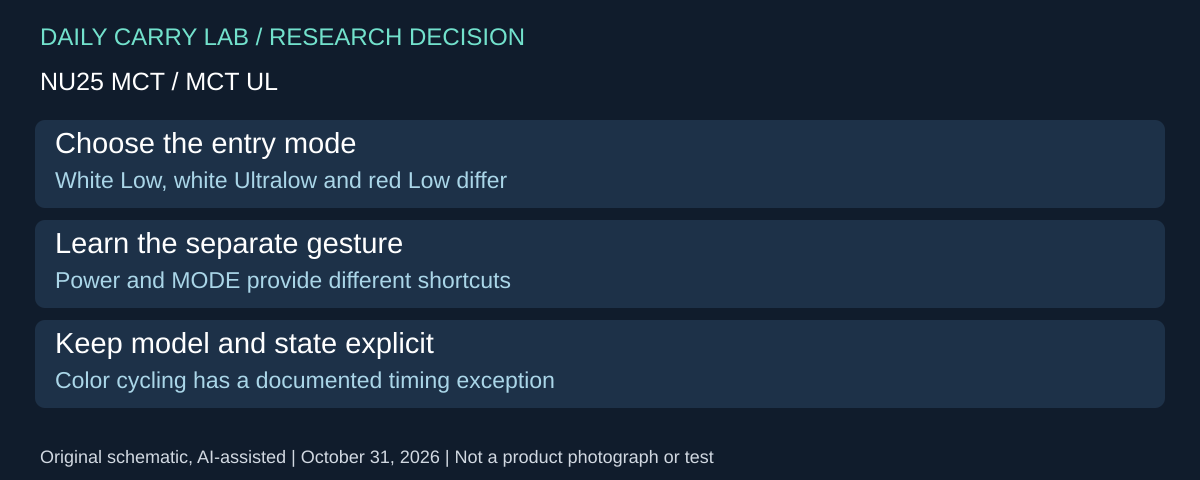
If your trip includes a shared room or tent, choose the entry mode as well as the maximum output. The NU25 MCT / MCT UL manual, checked October 31, 2026, documents separate starting actions for neutral-white Low, neutral-white Ultralow and red Low. That adds a practical control choice to the battery comparison above.
| Start with the light off | Documented action | Planning consequence |
|---|---|---|
| Neutral-white Low | Hold Power for one second | This is different from the Ultralow shortcut |
| Neutral-white Ultralow | Double-press Power | Learn the separate gesture before entering a dark shared space |
| Red Low | Hold MODE for one second | Red entry does not require cycling the white beam first |
When the primary light is on, Power cycles Low, Mid and High. The manual’s color-selection sequence also has a timing exception: after switching neutral to warm and waiting more than a minute without an operation, the next MODE press returns to neutral, skipping cool for that cycle. Do not assume every short press always produces the same color regardless of the preceding state.
Our selection advice is to rehearse these controls with a working light before packing. Decide whether the direct shortcuts are easier for your routine than the controls on the lamp already owned. A low-mode label does not establish that another person will be undisturbed, and a red source does not certify preservation of night vision for every task. We have not tested button feel, darkness adaptation, room disturbance or accidental activation.
Budget and drawback: this may justify choosing a control scheme, but does not establish a need to replace a serviceable lamp. Complete lamp, charging and backup-light totals remain unknown. Keep the existing lockout and battery constraints above; these shortcuts do not bypass a locked lamp. The instructions concern current MCT variants, not older NU25 generations or the Petzl alternatives.
HM50R V2.0: compare a detachable lamp and a different spare-cell system
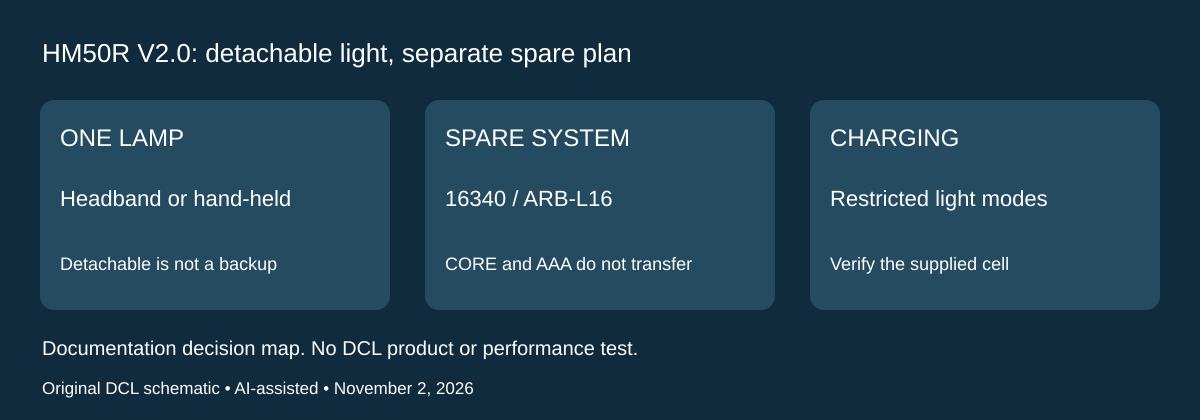
November 2, 2026 research addition: Fenix HM50R V2.0 introduces a documented detachable format to the existing headlamp comparison. Consider it when moving the same light between a headband and hand-held work is useful. Detaching one lamp does not create a second independent light, so the backup-light decision above remains separate.
Fenix’s current HM50R V2.0 page identifies a removable 16340 rechargeable lithium-ion battery and a detachable lamp body. The linked manual, revision A0 dated 20240521 documents its holder assembly and states that the detached lamp can serve as a work flashlight. This is a different mechanical and spare-parts plan from NU25 MCT UL’s built-in battery or ACTIK CORE’s CORE/AAA arrangement.
| Need | HM50R V2.0 documented choice | Drawback to resolve |
|---|---|---|
| One lamp for headband and hand-held tasks | Lamp detaches from its holder | Both uses depend on the same lamp and battery |
| Replace depleted energy away from USB | Manual recommends Fenix ARB-L16 series 16340 cells | CORE, R2250 and AAA spares do not transfer to this system |
| Recharge the included battery in the lamp | USB Type-C port; manual names ARB-L16-700P | Do not assume an unidentified seller’s cell is that documented kit |
| Use light during charging | Manual permits Low, Red and Red flash, with longer charging time | Do not buy expecting the full white-light mode range while charging |
The manual quotes about 1.5 hours for its named included rechargeable cell. That estimate does not establish the charging time of a different-capacity replacement. It also limits the battery-level indication and low-voltage warning to the named ARB-L16-700P. Identify the offered battery before relying on those indications; physical fit alone is insufficient evidence that a substitute behaves identically.
There is a material source discrepancy worth retaining: the current product page gives different beam-distance figures within itself, and its weight differs from this linked manual. We therefore do not use reach or weight to rank this model against the other headlamps. Resolve the exact offered revision if either measurement determines your purchase. The detachable construction and named battery plan are the supported comparison here.
Budget and selection: exact delivered lamp, protected spare-cell, storage and charging-kit totals are unknown. Verify the exact package and full battery instructions before ordering. Keep a suitable existing headlamp when detached use adds no value or would introduce another incompatible spare. We have not tested holder retention, field battery replacement, comfort, beam performance or charging. This source-only addition approves no retailer package or battery substitution.
Separate HM50R V2.0 dimming from an intermittent fault
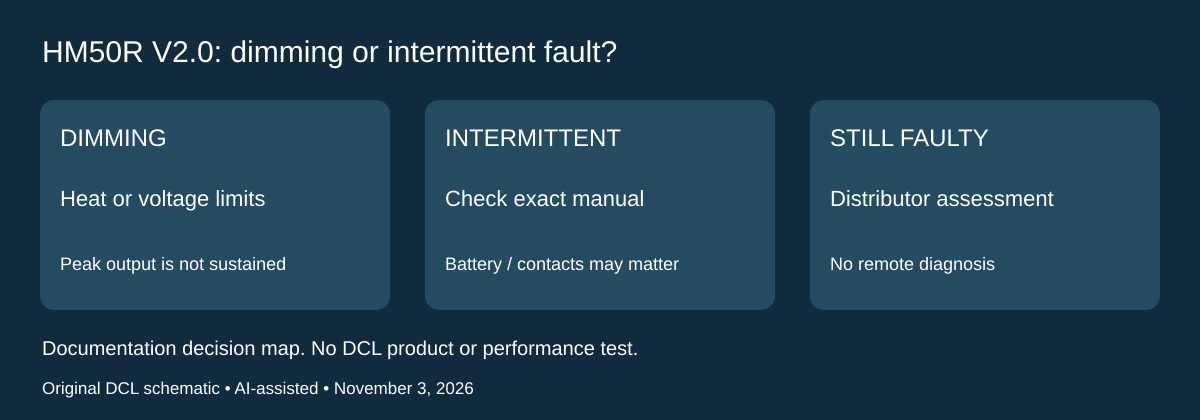
Documentation reviewed November 3, 2026. Before replacing an owned Fenix HM50R V2.0, distinguish a reduction in output from flickering or failure to light. Fenix’s exact-model FAQ, Q6–Q7 treats these as different troubleshooting questions. The linked manual’s English protection and maintenance sections corroborate them; our retained manual capture is dated November 2, rather than a newly issued revision.
The FAQ describes automatic reduction in Turbo when the lamp reaches 60°C or above. Below that threshold it allows Turbo to be selected again. Separately, falling voltage causes staged output reduction toward Low. With the manual’s named ARB-L16-700P battery, the Low-mode indicator warns when recharge or replacement is needed. Neither behavior by itself proves a worn-out LED or a need for a higher-output headlamp.
| Observed behavior | Manufacturer distinction | Purchase or support decision |
|---|---|---|
| Turbo reduces after use | Temperature protection may reduce output | More peak lumens do not establish a solution |
| Progressive reduction toward Low | Low-voltage response is documented | Assess the named compatible battery and charge state |
| Flickering or intermittent illumination | FAQ identifies battery and contact problems | Follow exact-model maintenance before declaring the lamp failed |
| Problem remains after documented checks | Manufacturer directs the user to the distributor | Obtain an assessment before buying parts or a replacement |
For dirty contacts, the maker specifies a cotton swab with rubbing alcohol. Keep that narrow contact-cleaning instruction separate from immersing or spraying the assembled lamp. The manual warns against disassembling the sealed head and calls for approved replacement O-rings when worn. It does not establish that any one symptom identifies the cause remotely, or that opening the sealed head is an appropriate repair.
Our selection advice is to preserve a functioning lamp when the observed change matches its documented operating limits. If your task needs sustained brightness that the current setup cannot provide, compare that requirement explicitly; do not buy solely from a larger Turbo headline. Keep the earlier separate backup-light plan and exact-cell restrictions.
Budget and drawback: the appropriate spare cell, approved seal, service and replacement totals are unknown. Contact care may avoid an unnecessary purchase, but DCL has not diagnosed a unit, measured temperature or tested a repair. The existing source discrepancies in weight and beam distance remain excluded from ranking. This section does not extend HM50R V2.0 procedures to the Petzl or NITECORE alternatives.
Sources and limits
This guide compares published specifications and source documentation. Daily Carry Lab has not performed hands-on tests of the products in this guide. Consult the dated sources and verify the exact model and current terms before buying.
- Primary documentation 1
- Primary documentation 2
- Primary documentation 3
- October 29 swift exact-model documentation
- October 29 swift-manual exact-model documentation
- October 30 headlamp primary documentation
- October 30 headlamp-guide primary documentation
- HM50R V2.0 current maker page; conflicting distance/weight excluded
- HM50R V2.0 A0 20240521 English Battery, Charging, Other Purpose and Included
- Exact-model FAQ Q6–Q7 read Nov3; direct download unavailable
- HM50R V2.0 A0 20240521 English protection and maintenance
Related guides
USB solar-panel output: shared watts, PD profiles and laptop limits
Read the USB ports separately from solar-panel wattage using exact Anker625 and NITECORE FSP30 documentation.
Off-grid phone charging: choose the solar panel and the whole kit
Plan an off-grid phone-charging kit using documented FSP30 size, power and USB limits without promised charging times.
iPhone 18 Pro: Wrist Strap or Crossbody Strap, with the right case
Compare exact Apple Wrist and Crossbody strap packages for iPhone 18 Pro by attachment, length, complete cost and limitations.
iPhone Duo cases: Apple Case versus Folio with Kickstand
Compare exact Apple iPhone Duo Case and Folio parts by coverage, viewing support, charging arrangements, separate equipment and dated US prices.