By Daily Carry Lab. Primary documentation checked October 13, 2026 (Pacific).
Affiliate disclosure: As an Amazon Associate, Daily Carry Lab earns from qualifying purchases. Retailer links may earn a commission at no extra cost to you. The manufacturer links here are evidence sources.
Research disclosure: This is a primary-documentation guide, not hands-on testing. Specifications and battery figures come from manufacturers. We assign no DCL rating, fit-test result or performance score.
A 100W solar panel can have a USB-C port rated for only 15W. The large number may describe a different output connector entirely. If your purchase question is whether a panel can supply your phone, power bank or USB-C laptop, start with the exact port’s voltage/current profiles and combined-output rules. Do not buy from the front-panel wattage alone.
The original comparison audits two documented output arrangements: Anker625 Solar Panel100W, using the Japanese A2431031-F0 manufacturer listing, and NITECORE FSP30. The Nomad 10 addition below extends the port comparison. This is a port-specification guide, not another off-grid phone-kit ranking. The off-grid charging guide owns deployment space, carried kit and battery-buffer planning.
Read each output separately
| Exact documented model | USB-C output | USB-A output | Combined or other output limit |
|---|---|---|---|
| Anker625, A2431031-F0 Japanese listing | 5V/3A,15W maximum | 5V/2.4A,12W maximum | USB-C plus USB-A together15W maximum; XT60 listed100W at26.5V/3.77A |
| NITECORE FSP30 | 5V/3A or9V/2A; up to18W PD advertised | Two ports; total5V/3.1A | Maker lists total panel output30W maximum; exact simultaneous USB-C/USB-A priority not established here |
Sources: Anker Japan625 specification and NITECORE FSP30 specification. We identify the Japanese Anker variant because that is the dated primary specification retrieved; it is not proof of US package contents, US stock or an identical undocumented revision. Match the label on the actual product you intend to buy.
For the Anker625, 15W USB-C plus12W USB-A does not mean27W simultaneous USB output. The page explicitly caps the two ports together at15W. Its XT60 figure belongs to a separate power-station connection; it must not be applied to the USB-C socket. Do not use a passive connector change as a substitute for documented electrical conversion or compatibility.
For FSP30,9V×2A is18W at the USB-C port. The two USB-A sockets share the manufacturer’s listed total rather than each promising5V/3.1A. We do not add all single-port figures and promise that total at once: the panel ceiling and undocumented simultaneous priorities remain separate limits. Neither page establishes the phone’s actual accepted rate under changing sunlight.
Does it charge a USB-C laptop?
| Device requirement | What these documented ports establish | What remains to verify |
|---|---|---|
| Phone that accepts5V USB input | Both makers document5V output profiles | Exact cable, phone input and available sunlight |
| Device needing9V PD | FSP30 explicitly lists9V/2A | Device negotiation and actual charging demand |
| Laptop needing a higher-voltage/higher-power PD source | Neither table establishes the required laptop profile | Exact laptop manual; do not assume merely from a USB-C socket |
| Power station | Anker lists separate XT60 output | Exact station voltage/current/connector compatibility; not USB laptop charging |
A laptop may reject an unsuitable low-power source or behave differently depending on its model and state. We establish no laptop charging guarantee here. In particular, the Anker panel’s100W name does not make it a100W USB-C PD laptop charger. Check the laptop’s accepted profiles and minimum practical input in its primary documentation; a cable rated for more watts cannot create missing voltage profiles at the panel.
Smart IC and restart claims need their own evidence
Neither captured primary specification establishes automatic recovery after shade for your exact device, or an exact simultaneous-port priority sequence. A generic smart-IC phrase would not demonstrate those behaviors. We retain them as unknowns rather than claiming uninterrupted charging, universal device detection or guaranteed restart.
If automatic recovery is essential, request the exact model’s current manual or manufacturer confirmation covering your planned port and device. A buyer can then check behavior with the intended cable and device. That is a verification step, not a DCL-tested feature. A bank used as a buffer also requires its own input and charge-through documentation; it does not change the panel’s output ratings.
Use a cable matching both end connectors and the required charging specification. A phone cable and a power-station lead solve different connections. Keep data/video requirements separate from charging; the USB-C cable guide explains why watts alone do not establish those capabilities.
Budget and selection limits
| Candidate or approach | Exact price evidence, October13,2026 | Budget implication and drawback |
|---|---|---|
| Owned compatible charging source | No panel purchase if already adequate | May solve the charging need without solar deployment |
| Anker625 exact listed variant | Local delivered checkout price not established | Buying a100W panel for USB alone gives a documented15W shared USB ceiling |
| FSP30 | Delivered checkout price not established | 18W USB-C profile is useful only if it matches the device; restart remains unknown |
We assign no unsupported price band, stock statement or universal winner. Choose by the required port profile and shared limit. If the exact device needs more than those documented USB outputs, remove the panel from that device’s shortlist rather than interpreting its total solar rating as an upgrade.
Small-panel shortlist: Nomad 10 is a 5V USB decision
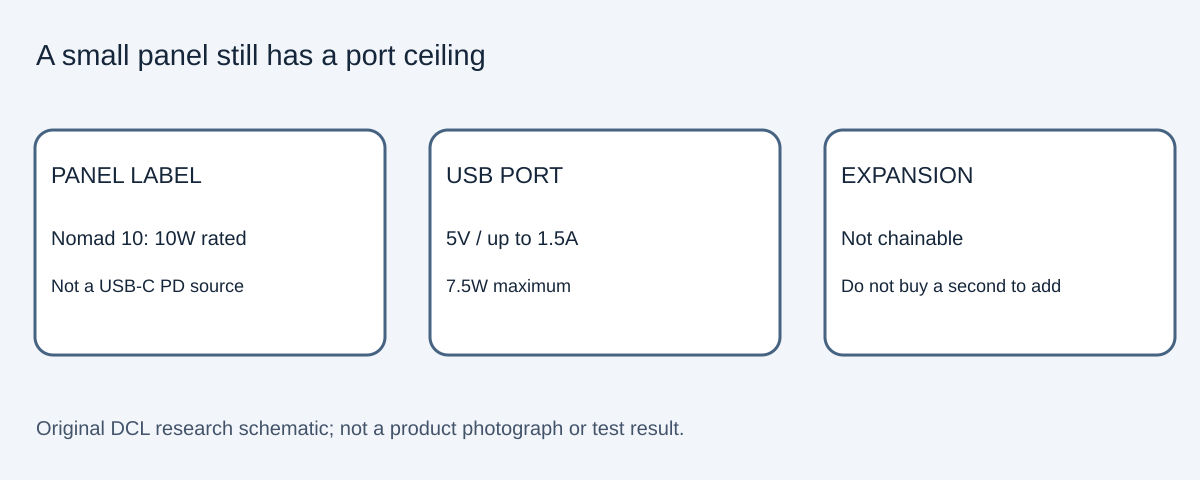
Added research checked October 31, 2026. Goal Zero Nomad 10, SKU 11900, is rated 10W at the panel but lists USB output at 5V, up to 1.5A: 7.5W maximum. No higher-voltage PD mode is established.
| Requirement | Nomad 10 evidence | Decision |
|---|---|---|
| Small 5V USB device | 7.5W port ceiling | Check device and cable |
| Higher-voltage PD laptop | Required profile absent | Remove from that shortlist |
| Combine two panels | Nomad 10 is not chainable | A second is no output upgrade |
| After-dark charging | Listed box contains the panel | Add a documented bank if needed |
The maker lists 0.51kg and folded dimensions of 24.1 × 18.4 × 3.2cm. Lower output does not establish a smaller complete kit. Delivered panel/bank/cable totals and actual charging performance remain unknown. Choose around a compatible 5V load; no DCL restart, charge-time or efficiency test supports this option.
Sources and limits
This guide compares published specifications and source documentation. Daily Carry Lab has not performed hands-on tests of the products in this guide. Consult the dated sources and verify the exact model and current terms before buying.
Related guides
Rechargeable headlamps: choose modes and a spare-power plan
Compare removable-cell headlamps with NU25 MCT UL built-in battery, light colors and complete charging kit. Manufacturer research, not testing.
Off-grid phone charging: choose the solar panel and the whole kit
Plan an off-grid phone-charging kit using documented FSP30 size, power and USB limits without promised charging times.
iPhone 18 Pro: Wrist Strap or Crossbody Strap, with the right case
Compare exact Apple Wrist and Crossbody strap packages for iPhone 18 Pro by attachment, length, complete cost and limitations.
iPhone Duo cases: Apple Case versus Folio with Kickstand
Compare exact Apple iPhone Duo Case and Folio parts by coverage, viewing support, charging arrangements, separate equipment and dated US prices.