By Daily Carry Lab. Primary documentation checked October 13, 2026 (Pacific).
October 23, 2026 research update: New exact A9129 international-input support clarification versus historical product-page conflict; separate input acceptance from attached load and voltage conversion. Earlier source dates remain unchanged.
Affiliate disclosure: As an Amazon Associate, Daily Carry Lab earns from qualifying purchases. Retailer links may earn a commission at no extra cost to you. The manufacturer links here are evidence sources.
Research disclosure: This is a primary-documentation guide, not hands-on testing. Specifications and battery figures come from manufacturers. We assign no DCL rating, fit-test result or performance score.
A power strip solves two different needs: access to more AC sockets and charging through built-in USB ports. Its AC rating does not tell you the power available from every USB port, and a “67W” label does not mean two connected laptops each receive 67W.
This guide uses the Anker Nano Charging Station A9129 as a documented allocation example. We chose it because its current manufacturer page exposes the output combinations, dimensions and electrical rating. We exclude the old guide’s other strip listings where exact primary input and sharing evidence was not established. This is a charging-layout decision, not a measured safety, heat or durability comparison.
Resolve input and load before packing
| Check | A9129 manufacturer evidence | Decision limit |
|---|---|---|
| AC electrical rating | 125V AC, 60Hz, 15A; 1875W maximum | Treat this as the documented AC rating, not authorization for a 230V AC load |
| Broad input wording | Page also says 100–240V, 50–60Hz | Does not resolve the separately stated 125V AC rating |
| USB-module wording | Note says built-in USB module supports 125–240V, 50/60Hz | Conflicts with the broad input statement; see the October 23 support clarification below |
| Surge/fuse protection | Exact surge rating and fuse behavior not established from retrieved primary material | Do not choose it for an assumed surge or fused-protection function |
These statements were recorded on the A9129 product page in the original research. The October 23 support clarification below supplies exact-model input guidance. It does not establish voltage conversion or a revised destination-specific AC load table; match the actual unit and attached appliances separately.
For a trip, first list which devices actually need AC. A laptop and phone that can charge over USB may need only a documented wall charger. Choose a strip when the extra AC sockets or cord placement solve a real outlet-access problem. A plug-shape requirement belongs to the international adapter guide; that guide does not override this strip’s electrical limits.
Read every connected-port combination
| Connected ports | A9129 documented maximum allocation | Practical consequence |
|---|---|---|
| One USB-C port | Up to 67W; profile includes 20V/3.35A | Single-port headline only; device and cable must support the needed charging path |
| C1 and C2 | 20W + 45W | Assign the higher-demand device to the appropriate port; not 67W each |
| One USB-C and one USB-A | 45W + 12W | Adding an accessory reduces the C-port ceiling |
| Both USB-A ports | 15W shared | The pair does not receive 15W each |
| C1, C2 and one USB-A | 20W + 30W + 12W | Two USB-C devices further reduce the higher C allocation |
| One USB-C and both USB-A | 45W + 15W shared by the A pair | Budget the A pair together |
| All four USB ports | 20W + 30W + 15W shared by the A pair | The laptop-facing port no longer offers its single-port headline |
Source: A9129 output specification table. These are ceilings, not DCL measurements or promised delivery to every device. A laptop that needs more power than its allocated port provides may charge slowly or draw down its battery during work; that is a conditional power-budget concern, not a measured result for your laptop.
Plan the complete overnight arrangement before buying. If the laptop needs the highest available C-port allocation, compare the actual combination with your laptop’s requirement and cable. If one strip cannot meet that need while other devices charge, separate the jobs or use a multiport wall charger whose exact sharing table fits. Do not compare devices by adding their single-port maximums.
Check packing and permission separately
Anker lists two AC sockets, two USB-C ports, two USB-A ports, dimensions of 3.94 × 3.66 × 0.75 inches and weight of 13.7oz. These manufacturer figures help estimate bag space; we did not test socket spacing, cable access or travel fit. Make sure your actual plugs can be placed as intended without assuming a product render establishes clearance.
Cruise operators, hotels and venues can impose equipment restrictions. No “cruise approved” claim is made for A9129 here, and no surge-protection assumption settles an operator’s policy. Check the actual operator’s current requirements if that affects the trip. This page is the strip cluster’s AC/USB decision hub; legacy hotel and carry-on lists are not additional recommendations or independent testing evidence.
Budget and selection limits
| Arrangement | Price evidence, October 13, 2026 | Reason to compare | Drawback |
|---|---|---|---|
| Existing documented charger | No new charger purchase if already owned; other costs unknown | May cover an all-USB kit | Does not add AC sockets or solve cord placement |
| A9129 strip | Exact current US checkout price not established | Explicit USB sharing table and extra AC sockets | Check the updated input guidance below; protection and destination-specific load details remain unverified |
| Different strip | Price and exact model evidence not established | Could address a missing input or load requirement | Must document its own AC and shared-USB limits before recommendation |
Choose by the exact electrical arrangement and power allocation. We do not name an international strip winner, assign a safety score or promise every device reaches its advertised charging rate.
A9129 international input: new support clarification, separate load checks
Anker now supplies a more specific primary clarification for the voltage conflict recorded above. Its international-input support article, retrieved October 23, explicitly lists A9129 among models supporting 100–240V input for travel. It says manuals for that list may state 125V because of certification requirements and notes that a plug adapter may be needed. This is the manufacturer’s guidance, not a DCL electrical test or an independently established certification conclusion.
That improves the evidence for this exact model’s input. It does not supply a revised country-by-country AC output/load table, establish voltage conversion, or prove that a particular attached appliance is suitable for the destination supply. Keep those questions separate before buying a strip for an overseas trip.
| Question before purchase | Evidence now available | Remaining decision |
|---|---|---|
| Does Anker explicitly name A9129 for 100–240V input? | Yes, in the linked support article | Match the actual model and regional unit; do not infer from a similar Nano name |
| Does this clarify every attached AC appliance? | No exact appliance approval or destination load table was established | Check the appliance label and obtain manufacturer clarification for the full arrangement |
| Does a plug adapter establish voltage conversion? | The article only notes a possible adapter requirement | Treat plug shape and electrical compatibility as separate checks |
| Does this apply to every Anker strip? | No; the article separates other model numbers into a restricted-input list | Check each exact model independently rather than buying by brand |
For an all-USB phone/laptop kit, compare a documented wall charger as well: it may already solve the charging need without additional AC outlets. If the cord position or two AC sockets are essential, write down the destination supply, exact strip, connected appliance ratings and USB port allocation. Resolve any mismatch before purchase; the source’s input statement is not a reason to ignore the unit’s own instructions.
Budget and drawback: current strip, adapter and complete delivered cost are unknown. Reuse equipment whose documentation already matches the trip when possible. A new strip adds cord and socket access, but the 67W headline still does not become two simultaneous 67W laptop outputs; the sharing table remains the relevant USB limit. This clarification changes no retailer mapping, cruise permission or surge-protection claim. No new safety rating or hands-on result is introduced.
For a higher-power laptop, compare occupied ports before upgrading the strip
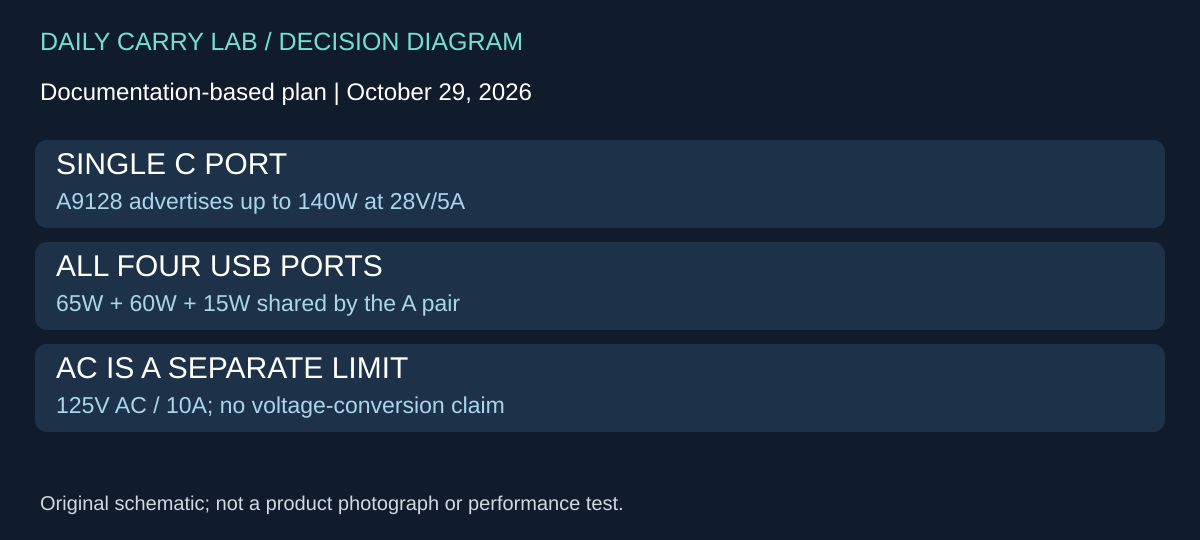
The A9129’s 67W headline may rule it out when one laptop needs more. Anker Prime A9128, the 6-in-1 140W station, supplies a different documented USB allocation. Consider it when the higher single-port capability or cord placement solves a real requirement. It is not two simultaneous 140W laptop ports, and it does not inherit the A9129’s electrical details.
The A9128 manufacturer specification table, retrieved October 29, 2026, lists 28V/5A, up to 140W, for one USB-C port. The same page requires a 5A e-marked cable for its higher-power charging. Check the laptop’s actual required profile and the cable together. A source ceiling is not a measured charging rate.
| A9128 USB arrangement | Manufacturer allocation | Purchase implication |
|---|---|---|
| One USB-C port | Up to 140W | Relevant only if source, cable and laptop support the required path |
| Both USB-C ports | Up to 65W + 65W | A second laptop removes the single-port headline |
| Both USB-C plus one USB-A | Up to 65W + 60W + 12W | Assign each device against the occupied-port table |
| All four USB ports | Up to 65W + 60W + 15W shared by the USB-A pair | Do not give each USB-A device a separate 15W budget |
Its listed dimensions are 6.3 × 3.1 × 0.7 inches, with weight 16.16oz, and a five-foot cord including the plug. Compare those with A9129’s figures above only as bare-product packing information. We have not measured either complete kit or checked plug spacing.
The A9128 page separately states 125V AC, 60Hz, 10A, a 1000W maximum connected load, and 100–240V support for its USB ports. It expressly says there is no surge protection. Those separate statements do not establish a revised overseas AC load rating or voltage conversion. Resolve the actual regional unit and attached AC appliances with manufacturer guidance before using it abroad. This addition makes no cruise-permission or safety-ranking claim.
Our selection advice is to write down the configuration you will actually use, including small USB-A accessories. A high-power single laptop at one time is a different need from a laptop, tablet and two accessories charging together. If the all-port allocation remains inadequate, investigate a documented separate supply or charge at different times; another headline total does not solve that automatically.
Budget and drawback: current delivered station, cable and adapter totals are unknown. Extra mass and the lower occupied-port ceilings may outweigh the single-port upgrade for a modest laptop. Keep a suitable existing strip when it already meets the plan. This candidate remains source-only; no exact retailer package or availability is approved. DCL has not tested temperature, sustained output or overseas operation.
Sources and limits
This guide compares published specifications and source documentation. Daily Carry Lab has not performed hands-on tests of the products in this guide. Consult the dated sources and verify the exact model and current terms before buying.
Related guides
iPhone 18 Pro: Wrist Strap or Crossbody Strap, with the right case
Compare exact Apple Wrist and Crossbody strap packages for iPhone 18 Pro by attachment, length, complete cost and limitations.
iPhone Duo cases: Apple Case versus Folio with Kickstand
Compare exact Apple iPhone Duo Case and Folio parts by coverage, viewing support, charging arrangements, separate equipment and dated US prices.
Portable label makers: choose phone control or a built-in keyboard
Compare Brother PT-P300BT CUBE and PT-H110 by phone dependence, TZe tape widths, power and cable-label workflow.
Travel AA/AAA chargers: match the cells, slots and USB input
Compare four-slot AA/AAA charging systems by exact chemistry and USB input. Includes conditional XTAR BC4 research and explicit operating-manual limits.