By Daily Carry Lab. Base specifications checked October 13; Small strap-system documentation checked October 15, 2026 (Pacific).
October 23, 2026 research update: Slim Pouch 2 nylon exact current generation, external depth and hanging access versus divided/removable organization; no inherited original Slim identity. Earlier source dates remain unchanged.
Affiliate disclosure: As an Amazon Associate, Daily Carry Lab earns from qualifying purchases. Retailer links may earn a commission at no extra cost to you. Manufacturer links here provide the evidence used for selection.
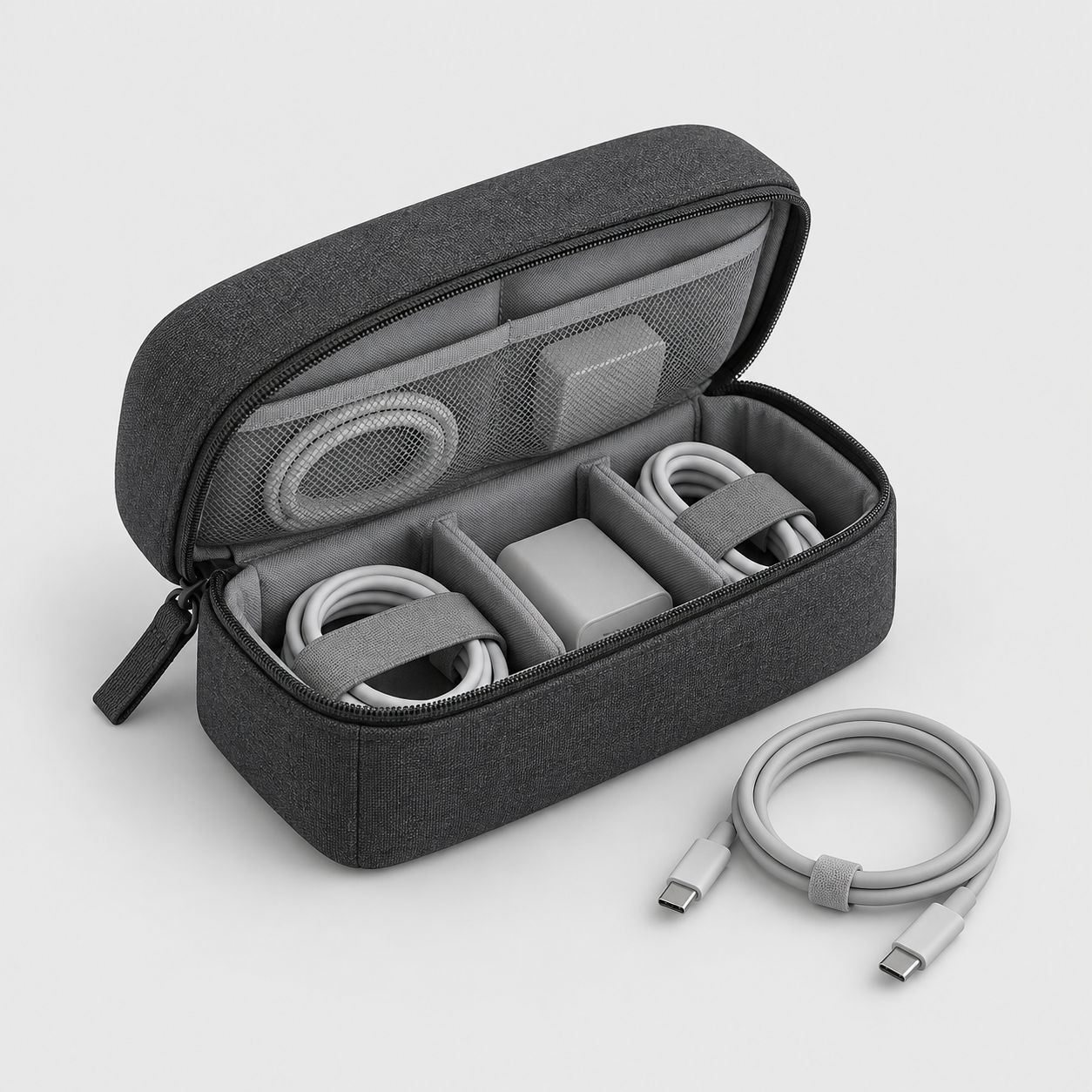
Choose a tech pouch around the charger, coiled cables and small accessories you actually carry. A pouch’s exterior dimensions describe the space it takes in your bag; they do not establish the clear space in any internal pocket. Buying the largest published volume can still leave you with the wrong shape for one bulky charger.
This guide compares Peak Design’s Small and Regular Tech Pouch and Orbitkey’s 2-in-1 Tech Accessory Pouch using manufacturer documentation. We selected them for distinct size and access choices, not a tested ranking. Daily Carry Lab has not packed these pouches, measured their pockets, tested zippers or established long-term durability.
Compare the documented models
Scroll horizontally to read all comparison columns →
| Model | Manufacturer dimensions | Storage decision | Main limitation |
|---|---|---|---|
| Peak Design Small Tech Pouch, Black BTP-S-BK-1 | External 240 × 115 × 90 mm; internal 230 × 105 × 80 mm; 1 L | Compare for a smaller kit with divided storage | Whole-pouch interior figures are not each pocket’s usable clearance |
| Peak Design Regular Tech Pouch | External 240 × 150 × 100 mm; listed internal 190 × 130 × 50 mm | Compare when the Small format does not suit your kit | Confirm the exact variant; the Small model’s interior measurements must not be reused |
| Orbitkey 2-in-1 Tech Accessory Pouch | External 230 × 140 × 80 mm | Compare when detachable desk storage is useful | The cited page does not establish pocket clearances for your charger |
Sources: Peak Design Small selection, Regular selection, Orbitkey specifications. Values are published specifications rather than DCL measurements. Nominal internal figures are shaped by dividers and construction; they do not certify a rectangular item will enter or close comfortably.
Peak Design Small: begin here for a deliberately limited kit
The Small model’s published exterior is lower in height than the Regular’s, while the stated length is the same. Compare it for a charging kit you want to keep compact, not because “Small” proves it fits every sling or backpack. The Small page identifies a 1 L capacity; do not silently assign the Regular model’s specifications to it.
Drawback: a stated interior envelope is not a packing plan. A charger may fit within three nominal dimensions while its plug, cable bend or the pouch’s dividers prevent the combination fitting. Ask about the relevant pocket or test your own kit within the seller’s return terms. We do not repeat a universal all-chargers fit promise.
Peak Design Regular: a different size, not automatic compatibility
The Regular variant’s published exterior is taller and deeper. It is the candidate to investigate if your required kit does not suit the Small format. Its listed interior dimensions also differ, so comparing only total volume or the shared brand name misses the actual question.
Drawback: the larger exterior occupies more bag space. Published interior figures should not be treated as a standardized, directly comparable rigid box: pocket geometry and the measurement method matter. Confirm the exact model and the space needed by your largest item before paying for more capacity.
Orbitkey 2-in-1: when part of the kit moves to the desk
Orbitkey documents an included removable Desk Pouch, a fold-down access panel, a collapsible divider and an external zip pocket with a cable pass-through. This is a candidate when you want to move a smaller set of accessories out of the main pouch at your desk. Its page lists 257 g with the Desk Pouch and 155 g without it. Orbitkey design and specification details.
Drawback: removable organization adds another piece to manage, and external dimensions do not confirm your charger fits in that removable section. The manufacturer’s configuration explains the use case; it does not prove faster access or better organization in a DCL test.
Budget, compatibility and drawbacks before checkout
Scroll horizontally to read all comparison columns →
| Need | Fit information to obtain | Spending decision |
|---|---|---|
| One charger and a few cables | Largest item dimensions with plugs, cable coils and closure room | Try an existing pouch first; no purchase required if it works |
| Separate desk and travel kits | Removable section’s actual opening and usable space | Pay for modular storage only if you will use it |
| Larger charger or power bank | Pocket dimensions, not just whole-pouch litres | Current exact-model checkout totals unknown; no budget ranking here |
| A narrow backpack compartment | External packed dimensions and zip opening | Include delivery and return cost when comparing total spend |
Prices and availability are not verified in this guide. The previous Bellroy, Tomtoc and original Aer recommendations are not retained merely because they appeared in the old list. The October 23 Slim Pouch 2 section below documents a separate, exact-generation addition; it does not restore an older Slim identity. Bellroy’s captured Compact destination did not expose usable model-specific dimensions in this retrieval. That gap is not evidence the product is unsuitable; it is a reason to avoid inventing a comparison row.
Make a packing checklist from your own kit
First, list what must travel: charger, specific cable lengths, adapters, power bank and any small storage or audio accessory. Separate essentials from duplicates. A pouch cannot make an overfilled kit lighter.
Measure the charger with its plug in the position you will pack it. Check for removable regional plugs and avoid assuming a folded-plug product shares the same packed profile as a fixed-plug version. Record cable-coil size without sharply bending connectors. Compare those measurements with the relevant pocket and its opening.
Then measure the bag compartment and entry zip. Leave room for the pouch when filled, rather than comparing an empty-product photograph with a flat compartment. Keep liquids separately; none of this research establishes leak isolation or waterproof protection.
Finally, place daily-use items where you can reach them without spilling the rest. That is a packing method to try, not a claim that we observed a particular pouch retrieve cables faster. For the cable capability decision, use our USB-C cable guide; for power during a journey, see the source-based car-charger guide.
Does the biggest pouch fit the biggest charger? Not necessarily. A pocket opening, divider or plug can be the limiting dimension even when the whole pouch is larger.
Which should I compare first? Start with Small for a limited kit, Regular if that shape is inadequate, and Orbitkey if detachable desk storage solves a specific need. Those are source-based starting points, not tested performance awards.
Backpack insert, Small sling or removable desk kit?
The selected Small Tech Pouch page identifies two Cord Hook loops for attaching a Peak Design camera strap or carry strap, sold separately, to turn the pouch into a sling. The embedded description is attached to “Tech Pouch | Small | Black”; this is not a claim borrowed from the Regular variant’s photographs. The documented attachment gives Small a second carrying option, but it does not establish how a loaded kit feels against your body.
Scroll horizontally to read all comparison columns →
| Carrying choice | What the documentation establishes | Access and closure check | Extra spending or drawback |
|---|---|---|---|
| Pouch inside your backpack | Small and Regular have different exterior envelopes | Try reaching the pouch and opening it without emptying the bag | No strap purchase needed; a second bag opening stands between you and cables |
| Small converted to a sling | Two Cord Hook loops accept a separately sold PD camera/carry strap | Check the exact strap attachment and opening orientation before carrying electronics | Strap cost is additional and unverified; loaded stability and comfort are untested |
| Orbitkey removable desk kit | The 2-in-1 includes a removable Desk Pouch | Decide which items stay in the main pouch and which move to the desk | Another piece to remember; removable-section clearances remain unknown |
Choose the backpack insert when the charging kit only needs to move from bag to desk. Consider the Small sling conversion when you actually need to carry the kit independently. Choose detachable desk storage when the same few accessories leave the main bag repeatedly. These are different access decisions; attaching a strap does not make the pouch’s internal pockets larger.
Before paying for a sling configuration, list the total kit: exact Small pouch, compatible PD strap and your charger/cables. Confirm the strap’s connector arrangement for the two Cord Hook loops rather than buying by brand alone. A photograph featuring another attachment system is not a substitute for matching the hardware. This guide does not certify arbitrary third-party straps, a maximum carried load or a Regular-pouch strap configuration.
Practise opening the pouch over a desk with your own items before relying on it while standing. Decide whether you need two hands to reach a cable, where the opening faces and whether removing one item dislodges another. Those are proposed checks for the owner; DCL has not performed them. Keep the zipper closed for carrying and do not treat a weather-resistance description as tested waterproof protection for electronics.
Does Small include a shoulder strap? The selected description says the camera/carry strap is sold separately. Count it as an additional purchase if you do not already own a suitable one. Its current price and the complete configuration total are unknown here.
Can I buy using a similar photograph? Match the exact Small BTP-S-BK-1, Regular BTP-BK-3 or Orbitkey 2-in-1 configuration. Their identities and storage designs differ. This update preserves the existing retailer mappings; it does not approve a different size, strap bundle or image based on appearance.
Cable pass-through: storage access is different from powered use
A pass-through helps route a cable; it does not establish that every power bank can operate inside the pocket. Orbitkey documents an external zip pocket with a cable pass-through on its 2-in-1 pouch. Select that feature for cable access only after checking the operating instructions for the device you intend to connect.
For a concrete example, the Anker A110R operating instructions identify an open fan ventilation grille and require use in a well-ventilated area with that grille unobstructed. That is an instruction for this exact power bank, not a claim that all power banks have a fan. It does not certify any pouch, pocket or partially open zipper as an adequate operating environment.
Our packing recommendation is to separate carrying from charging: take the power bank out before use, place it where its own ventilation requirements can be met, and keep the pouch for disconnected accessories. This is a practical workflow derived from the documented operating constraint. DCL has not compared temperatures inside and outside these pouches, and this update does not identify Orbitkey as unsafe.
Scroll horizontally to read all comparison columns →
| Situation | Compatibility check | Budget and drawback |
|---|---|---|
| Carry a disconnected power bank | Compare its dimensions, connector protection and pocket opening | Try your existing pouch first; no added purchase if it fits |
| Use the Orbitkey cable pass-through | Confirm cable access and the connected device’s operating instructions separately | A storage feature is not thermal certification; exact checkout total is unverified |
| Operate a fan-equipped A110R | Unpack it and keep its ventilation grille clear in a well-ventilated area | Requires space outside the pouch; no new power-bank recommendation or retailer mapping |
| Put a kit away after use | Disconnect, inspect and follow the device’s storage instructions | Packing tightly around an attached connector can defeat usable clearance |
At your desk, remove the power bank before routing cables. Check that the cable reaches without tension at either connector and that the plug and cable bend do not obstruct the device’s grille. Arrange the phone and power bank according to their own instructions. The pouch’s volume and zipper position cannot answer those device-specific questions.
Before repacking, disconnect the kit and check the manufacturer’s storage guidance. A cable that enters the pocket is not proof that the connector has enough clearance when the pouch closes. Do not force closure against a plug. These are owner checks to perform with your actual kit; no fit, charging-speed or temperature result is claimed here.
Can I leave the zipper open instead? This research does not establish a sufficient opening size or airflow rate. Follow the power bank’s instructions and unpack it so those requirements can be checked directly.
Should I buy a different pouch to charge inside it? We have no evidence that one of these pouches certifies that use. Keep the original size/access decision and budget comparison above; this section changes the packing workflow, not the approved Small, Regular or Orbitkey product identities. Added operating documentation checked October 16, 2026.
Slim Pouch 2: compare depth before buying more divided storage
Aer now provides usable documentation for Slim Pouch 2. That exact generation is an additional source-based candidate; it is not a recovered specification for an older Slim Pouch or proof of an Amazon offer. The current Aer nylon product page, checked October 23, lists a 23 × 13 × 5 cm exterior, 1.5 L volume and 0.37 lb weight. Its nylon version describes a 1680D CORDURA exterior. Do not transfer these specifications to the separately named X-Pac variant.
This adds a different packing question to the earlier divided and removable choices: would a shallower exterior solve your bag-space problem? The Small Peak Design exterior above is 9 cm deep; Aer’s stated 5 cm is a different exterior envelope. Neither figure tells you whether a particular charger passes through an internal opening.
Scroll horizontally to read all comparison columns →
| Choice | Documented access design | Compatibility and drawback |
|---|---|---|
| Aer Slim Pouch 2, nylon | Wide-access main compartment, front pocket, grab/hanging loop; described as self-standing | Exact usable pocket clearances unknown; self-standing is a maker description, not a loaded stability test |
| Peak Design Small | Divided storage and separately purchased strap option described above | Deeper stated exterior; pocket geometry still matters |
| Orbitkey 2-in-1 | Removable desk section | Useful when part of the kit leaves the bag; adds a separate piece to manage |
Choose Aer for investigation when exterior depth is the binding constraint and the access arrangement matches your routine. Choose removable organization when moving a smaller desk kit is the actual need. A nominal 1.5 L figure does not prove Aer holds a particular 1 L pouch’s contents better: dividers, opening geometry and bulky plugs can determine the result.
Make a list of the charger, folded plug, adapters and cable coils before ordering. Obtain the relevant opening and compartment dimensions if fit is close. The hanging loop is documented as an access/carry feature; this guide does not establish a rated hanging load or approve another shoulder-strap system. Keep powered-device ventilation checks separate from storage features, as described above.
Budget: the current delivered total for the exact nylon color/configuration is unverified here. Try an existing pouch first if it already fits. This addition changes the shortlist, not the approved Peak Design/Orbitkey retailer identities; Aer remains source-only. DCL has not packed, weighed or compared retrieval speed in Slim Pouch 2, and no waterproof or tested durability claim follows from its material description.
CAP2: compare a desk-opening layout with removable storage
Research disclosure: This addition uses manufacturer documentation; DCL has not packed, weighed or tested these pouches.
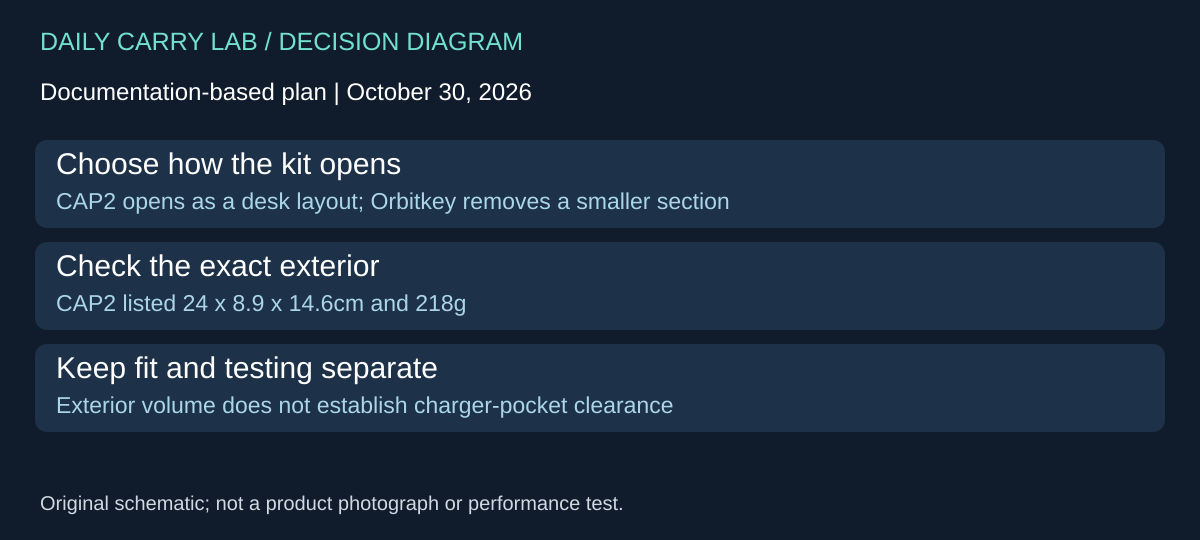
The EVERGOODS CIVIC Access Pouch 2L (CAP2) adds a desk-opening choice to this shortlist. Its manufacturer page, checked October 30, 2026, describes a pouch that stands flat and open, with an adjustable zippered divider. That is a different access choice from Orbitkey’s removable Desk Pouch.
Scroll horizontally to read all comparison columns →
| Candidate | Access decision | Limitation |
|---|---|---|
| CAP2 | Open the whole pouch on the desk | Reserve space for the open arrangement; loaded stability untested |
| Orbitkey 2-in-1 | Remove a smaller desk section | Another piece to manage |
| Aer Slim Pouch 2 | Investigate the shallower exterior above | Pocket clearance still needs checking |
EVERGOODS lists CAP2 at 24W × 8.9D × 14.6H cm and 218g. Exterior measurements and a 2L name do not establish an internal charger’s fit. Ask for the relevant opening and compartment dimensions when clearance is close. Do not transfer nylon specifications to X-Pac or other fabric editions.
Try arranging your own disconnected kit on the desk first. Decide whether everything should open together or only a removable subset. Delivered exact-variant cost is unknown; keep an existing pouch if it works. CAP2 remains source-only here, without a new retailer mapping, packing test or waterproof claim.
Cable Kit 3: separate quick access from the main charging kit
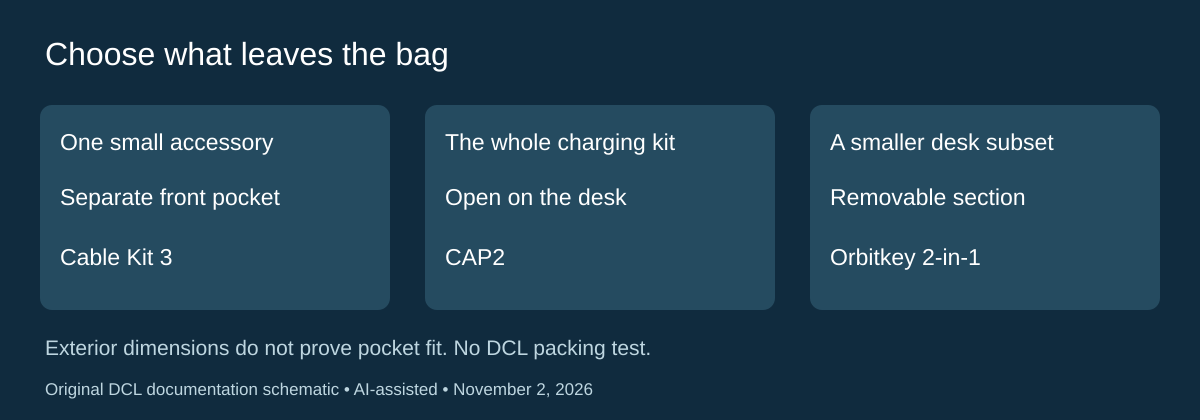
Research checked November 2, 2026. Aer Cable Kit 3, black nylon, adds a two-access choice: keep small frequently reached items in a front pocket while the main kit stays in the wide-access compartment. The manufacturer describes those separate openings. This is a reason to investigate its layout, not evidence that it holds more usable equipment than the divided or removable alternatives above.
The Apple listing for HSJU2ZM/A identifies manufacturer part AER31018, UPC 850042380550, and a box containing the organizer. Chargers, cables and other contents pictured with a pouch are not established as included by that box list. Match the black nylon model and those identifiers before comparing another seller’s offer. This addition supplies no Amazon mapping and does not approve a similarly named X-Pac version.
Scroll horizontally to read all comparison columns →
| Access need | Source-based candidate | Compatibility, budget and drawback |
|---|---|---|
| Reach a small adapter without opening the main charging kit | Cable Kit 3 front pocket plus wide-access main compartment | Pocket clearances are unpublished here; buy no fit promise from an exterior measurement |
| Put the whole kit open on a desk | CAP2, documented above | Requires desk space for that arrangement; loaded stability remains untested |
| Move a smaller subset out of the main pouch | Orbitkey removable Desk Pouch, documented above | Another separate piece to manage; decide whether removal is actually useful |
| Minimize the stated exterior depth | Slim Pouch 2 nylon, documented above | Its 5cm exterior is shallower than Cable Kit 3’s listed 7cm; neither establishes an internal charger’s fit |
Aer lists Cable Kit 3 at 25 × 15 × 7cm externally and 2.6L. Use that envelope to check the bag compartment first. Do not calculate usable pocket space from the volume: lining, openings and dividers are not represented by a simple exterior box. The maker’s inch and centimetre dimensions are rounded; a close clearance deserves a direct measurement rather than a conversion presented with false precision.
Try a two-zone layout with the disconnected kit you already own. Put the item you reach for most often aside, and check what still needs the main compartment. If you usually remove every accessory at the desk, another front opening may add little. If a small adapter is repeatedly needed while the rest stays packed, that access arrangement is worth checking. These are suggested owner checks, not DCL retrieval-speed or packing results.
For a tight fit, ask for the front-pocket opening and the usable dimensions of the relevant compartment. Apple’s device compatibility list does not certify a loaded charger-and-cable combination, and this guide makes no such inference. Keep the device ventilation and disconnected-storage guidance above; an additional pocket is not permission to operate a power bank inside it.
Budget and limits: delivered cost for the exact configuration is not established in this guide. Keep an existing pouch if rearranging its contents meets the same need. DCL has not packed or weighed Cable Kit 3, tested its resistance to water, or verified a retailer’s current stock. The two retrieved pages express weight differently; no comparative weight ranking is added. This is a source-based addition to the existing pouch comparison, with the earlier model-specific evidence dates preserved.
Shop the researched models
These Amazon links are affiliate links. Daily Carry Lab may earn a commission from qualifying purchases. Match the model and included contents to your needs; this guide is based on manufacturer-source research, without hands-on testing.
-
Peak Design Small BTP-S-BK-1
Check Peak Design Small BTP-S-BK-1 on Amazon -
Peak Design Regular BTP-BK-3
Check Peak Design Regular BTP-BK-3 on Amazon -
Orbitkey 2-in-1 WTP1-BLK-109
bundle with detachable sleeve
Check Orbitkey 2-in-1 WTP1-BLK-109 on Amazon (bundle with detachable sleeve)
Sources and limits
This guide compares published specifications and source documentation. Daily Carry Lab has not performed hands-on tests of the products in this guide. Consult the dated sources and verify the exact model and current terms before buying.
Related guides
iPhone 18 Pro: Wrist Strap or Crossbody Strap, with the right case
Compare exact Apple Wrist and Crossbody strap packages for iPhone 18 Pro by attachment, length, complete cost and limitations.
iPhone Duo cases: Apple Case versus Folio with Kickstand
Compare exact Apple iPhone Duo Case and Folio parts by coverage, viewing support, charging arrangements, separate equipment and dated US prices.
Portable label makers: choose phone control or a built-in keyboard
Compare Brother PT-P300BT CUBE and PT-H110 by phone dependence, TZe tape widths, power and cable-label workflow.
Travel AA/AAA chargers: match the cells, slots and USB input
Compare four-slot AA/AAA charging systems by exact chemistry and USB input. Includes conditional XTAR BC4 research and explicit operating-manual limits.