By Daily Carry Lab. Primary documentation checked October 13, 2026 (Pacific).
Affiliate disclosure: As an Amazon Associate, Daily Carry Lab earns from qualifying purchases. Retailer links may earn a commission at no extra cost to you. Manufacturer links here document sources.
Research disclosure: This guide uses primary documentation, not hands-on testing. Product figures are manufacturer ratings; no DCL score or benchmark is assigned.
Use a packing cube to organize garments, then reserve a separate protected space for electronics. A compression zipper is useful for clothing volume; it does not establish protection for a camera, screen, drive or battery. When one bag carries both, the useful decision is how to divide space without putting compression pressure through fragile gear.
We selected Peak Design Packing Cube Small and Medium, specifically the Charcoal BPC-S-CH-2 and BPC-M-CH-2 variants documented in the manufacturer’s current page data. This is a dimensional planning comparison, not a tested packing demonstration or a ranking of complete cube sets. We do not borrow specifications from Ultralight Packing Cubes, Camera Cubes or older revisions.
Choose a footprint before a volume headline
| Current Charcoal variant | Compressed dimensions | Expanded dimensions | Manufacturer volume |
|---|---|---|---|
| Small BPC-S-CH-2 | 32 ×17 ×8cm | 32 ×17 ×17cm | 4.5L compressed /9L expanded |
| Medium BPC-M-CH-2 | 32 ×32 ×8cm | 32 ×32 ×17cm | 8L compressed /18L expanded |
Peak Design Packing Cube specifications, checked October 13, 2026. These are manufacturer dimensions and capacity figures. They are not measured internal clearances or a guarantee that any particular pouch fits. Do not treat the product of nominal external dimensions as a measured usable volume.
Both options have an expansion/compression zipper. The page describes a separate clean/dirty compartment arrangement with a movable divider. That garment organization is useful when deciding how to separate worn clothing, but it does not establish liquid containment or a protective electronics divider. Source: Peak Design construction details.
The Medium’s footprint is wider than the Small’s. Before choosing it, measure the usable space inside your actual bag with its other compartments loaded. A bag’s total liter rating does not tell you whether the cube sits flat beside a protected electronics case, and exterior bag dimensions do not establish the opening clearance.
Draw three zones in your bag
| Zone | What belongs there | Compatibility check |
|---|---|---|
| Garment cube | Clothes that can tolerate the chosen compression | Footprint and expanded depth fit the available space |
| Protected electronics case | Fragile devices and accessories needing their own protection | Exact case clearance, closures and padding suit the devices |
| Accessible charging kit | The bank and cable you need during transit | They remain reachable without unpacking the garment cube |
Keep hard plugs and other protruding objects from pressing into screens. Plan the route by which you remove a device from its case: an arrangement that technically occupies the bag may still require taking everything out at a checkpoint or recharge stop. This is a packing method, not a claim that we have tested the illustrated combination.
Do not rely on clothing compression as camera padding. For a protective case, check its actual construction, internal clearance and closure independently. The tech organizer guide addresses access and charger/cable space; the backpack guide addresses sleeve and bag clearance. Neither turns a garment cube into a protective case.
Use compression on the garment side
Lay out the cube’s intended clothing load and keep electronics outside it. Decide whether you need expanded capacity at the destination or a compressed garment block during transit. If the filled cube crowds the electronics case or prevents the bag closing normally, revise the load or arrangement rather than assuming the zipper creates unlimited room.
Measure the loaded arrangement yourself before travel. DCL has not verified fit in a specific suitcase, backpack or pouch, and does not promise a particular number of garments. A manufacturer’s illustrative shirt count is not a packing guarantee for your clothing.
| Buying choice | Budget evidence on October 13, 2026 | Useful when | Drawback |
|---|---|---|---|
| Small documented cube | Current exact-variant US price not established | Its narrower footprint fits the garment plan | Less listed capacity than Medium; protection still separate |
| Medium documented cube | Current exact-variant US price not established | Your measured bag space accommodates the broader footprint | It can consume space reserved for electronics or access |
| Existing garment organizer plus separate case | New cube cost avoided if it fits; case cost unknown | You already have usable organization | Existing dimensions and device protection still need checking |
We have not tested abrasion, zipper force, weather resistance, padding or packed fit. There is no numeric budget ceiling, durability score or purchase-link identity in this revision. Choose the arrangement that preserves both garment organization and an independently suitable home for the electronics you carry.
Consider Smedium when the usable space falls between footprints
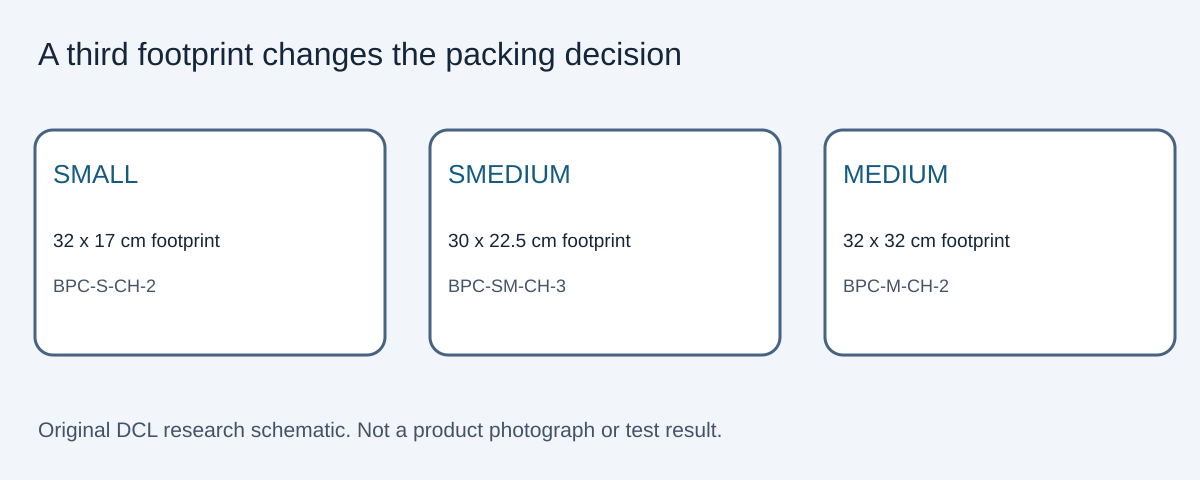
Small and Medium are not the only documented shapes. Peak Design’s current product data, checked October 30, 2026, identifies Smedium Charcoal BPC-SM-CH-3. Its specification lists a 30 × 22.5 × 8 cm compressed size, 30 × 22.5 × 17 cm expanded size and 127 g weight. The maker separately lists 10 L compressed and 15 L expanded capacity. Treat these as published values, not DCL measurements or volume calculated from external dimensions.
| Exact option | Nominal footprint | Reason to compare | Drawback in a mixed clothes-and-tech bag |
|---|---|---|---|
| Small BPC-S-CH-2 | 32 × 17 cm | A narrower garment strip may preserve adjacent gear space | Longer than Smedium on one side |
| Smedium BPC-SM-CH-3 | 30 × 22.5 cm | A shorter, wider garment block may fit a different gap | Wider than Small; not automatically a more compact fit |
| Medium BPC-M-CH-2 | 32 × 32 cm | A broader garment block may suit available space | Can crowd the separate electronics case |
Small and Medium dimensions above were also present in the October 30 page data. Do not transfer Smedium specifications to a similarly named Ultralight cube, another size or an unverified retailer bundle. The source specifies one cube in the package; accessories pictured alongside it do not establish a complete tech-protection kit.
Use paper templates or your own measurements to compare the nominal footprints inside your actual loaded bag. Then check the filled depth and the path for removing the electronics case. This is a suggested planning method, not a fit test we performed. Smedium does not make garment compression safe for screens or establish protective padding. Exact delivered prices for these variants and any additional electronics case remain unknown; assess that complete arrangement before buying a set to obtain a size you do not need.
Keep, repair or replace an owned Packing Cube
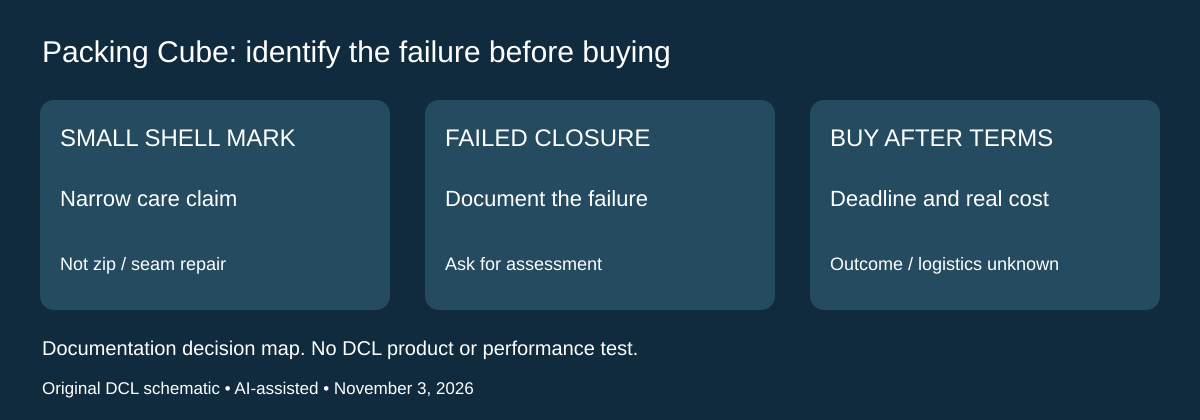
Research checked November 3, 2026. A worn Peak Design Packing Cube need not send you straight back to the size table. The Packing Cube product page describes rubbing a finger over small punctures and abrasions in its self-healing shell. That narrow material claim is not a repair instruction for a split seam, broken zip or large tear, and it does not restore electronics protection the cube never established.
For a closure that no longer functions normally, read the manufacturer’s current warranty and claim process before buying a replacement or modifying the cube. The policy distinguishes functional defects and failures during normal use from cosmetic wear and stains. It permits repair or replacement; a replacement may come from open-box, used or refurbished stock, rather than necessarily being a new retail unit. A claim still needs the manufacturer’s assessment.
| What has changed in your owned cube? | Decision before buying | Remaining limitation |
|---|---|---|
| Small shell puncture or abrasion | Consider the product page’s finger-rub method | No guarantee for a large tear, seam or closure failure |
| Staining or cosmetic wear while closure works | Judge whether it still serves the garment load | Cosmetic wear is outside the stated warranty coverage |
| Zip or other part no longer functions during normal use | Document the failure and request a warranty assessment | Remedy and turnaround are not established here |
| Cube is lost | Plan replacement around the required footprint | The stated policy excludes lost or stolen items |
Peak Design’s claim process starts with registering the gear in your account. For an item without a serial number, the instructions offer a No selection and the appropriate product choice. Record the failure and supply relevant photos or video; the company may request the item for inspection. We have not submitted a claim or verified an outcome for these cube revisions.
Our buying advice is to distinguish a failed closure from an unwanted appearance before purchasing another set. Keep electronics in their separate protective case during any garment-organizer failure or repair. Do not move this shell-care claim to the different Ultralight cube construction. Current replacement checkout cost, any return logistics and service turnaround remain unknown; compare those actual terms with your travel deadline before choosing a paid replacement. No DCL durability, repair-success or waterproofing test supports this advice.
Sources and limits
This guide compares published specifications and source documentation. Daily Carry Lab has not performed hands-on tests of the products in this guide. Consult the dated sources and verify the exact model and current terms before buying.
Related guides
iPhone 18 Pro: Wrist Strap or Crossbody Strap, with the right case
Compare exact Apple Wrist and Crossbody strap packages for iPhone 18 Pro by attachment, length, complete cost and limitations.
iPhone Duo cases: Apple Case versus Folio with Kickstand
Compare exact Apple iPhone Duo Case and Folio parts by coverage, viewing support, charging arrangements, separate equipment and dated US prices.
Portable label makers: choose phone control or a built-in keyboard
Compare Brother PT-P300BT CUBE and PT-H110 by phone dependence, TZe tape widths, power and cable-label workflow.
Travel AA/AAA chargers: match the cells, slots and USB input
Compare four-slot AA/AAA charging systems by exact chemistry and USB input. Includes conditional XTAR BC4 research and explicit operating-manual limits.