By Daily Carry Lab. Primary documentation checked October 13, 2026 (Pacific).
Affiliate disclosure: As an Amazon Associate, Daily Carry Lab earns from qualifying purchases. Retailer links may earn a commission at no extra cost to you. The manufacturer links here are evidence sources.
Research disclosure: This is a primary-documentation guide, not hands-on testing. Specifications and battery figures come from manufacturers. We assign no DCL rating, fit-test result or performance score.
Choose a pocket knife around the cutting work you actually have, whether you can carry it in the places you visit, and whether you will maintain it. A compact blade is not a legal clearance, and a locking folder is not a substitute for safe handling. If your everyday route includes places that prohibit knives, a knife-free kit may be the useful answer.
This guide compares two exact documented folders: CIVIVI Mini Praxis C18026C-1, the green G10/black stonewashed D2 variant, and Kershaw Misdirect 1365, the assisted-opening stainless-handle model. Their different dimensions, locks and opening arrangements give a concrete choice without inventing a universal winner. We removed unverified old picks and rankings. No DCL cutting, corrosion, sharpening or pocket-comfort testing supports this guide.
Compare the exact models
| Detail | Mini Praxis C18026C-1 | Misdirect 1365 |
|---|---|---|
| Blade length | 2.98 inches / 75.6mm | Current manufacturer page: 3 inches / 7.6cm |
| Closed length | 3.81 inches / 96.9mm | 4 inches / 10.1cm |
| Blade material | D2 | 4Cr14 |
| Handle | Green G10 | Stainless steel |
| Lock | Liner lock | Frame lock |
| Opening documentation | Flipper model; caged ceramic ball-bearing pivot | Assisted opening with flipper |
| Manufacturer weight | 2.77oz / 78.5g, knife | 3.2oz / 93g, as listed by Kershaw |
Sources: CIVIVI exact variant specifications and Kershaw Misdirect 1365. These are manufacturer measurements rather than our measurements. Kershaw’s ounce and gram figures are reproduced as listed; they are not a DCL unit conversion. Its current page differs from older 2.9-inch blade descriptions, so use the current specification and confirm the actual purchased model.
The Mini Praxis page distinguishes knife weight from packaged weight; do not compare its shipped parcel with another knife’s bare weight. It lists a 0.45-inch handle thickness and 0.62-inch overall height including the clip. Those dimensions describe different parts of the knife, so neither should silently stand in for the other when checking pocket space.
Choose the mechanism and carry arrangement
| Reader priority | Documented option to examine | Drawback or check |
|---|---|---|
| Smaller closed package and lower listed knife mass | Mini Praxis C18026C-1 | G10 texture, clip pressure and hand fit are untested here |
| Assisted flipper opening | Misdirect 1365 | Decide whether assisted operation is suitable and permitted for your route; do not infer legality from blade size |
| Specific pocketclip position | Misdirect lists right/left tip-up and right tip-down positions | Check your actual side and preferred orientation rather than assuming full ambidextrous operation |
| Simple model identification | Match the exact CIVIVI suffix or Kershaw model number | Similar family names can hide different steel, handle or mechanism specifications |
A liner lock and frame lock are distinct documented constructions, not comparative strength results. Learn how the specific lock releases and keep fingers away from the closing blade. If a mechanism is damaged, does not engage correctly or behaves unpredictably, stop using the knife and follow the maker’s service guidance. We do not infer that a lock cannot fail.
Consider where the clip will sit beside keys, a phone and other pocket items. Check the closed dimensions, access to the opening control and whether the handle shape works for your hand during a safe demonstration. None of those fit outcomes can be established from a product photograph alone. If your main need is scissors or several small implements rather than a dedicated cutting blade, use the keychain multitool guide.
Maintenance and restrictions are part of the decision
Steel names help identify the product; they do not establish which knife holds an edge longer or resists corrosion better in your conditions. Avoid a performance ranking without comparable tests. Budget time for the manufacturer’s cleaning, drying, lubrication and sharpening instructions. Do not select a knife on the assumption that it is maintenance-free or suitable as a pry tool.
For US air travel, the Department of Transportation’s baggage guidance, checked October 31, 2026, says not to pack a knife in a carry-on. Consult TSA and your airline for the exact current checked-bag and packing rules. Screening guidance does not establish permission at your destination or workplace; this guide supplies no universal legal blade-length threshold.
Before a trip, inspect the pockets and bags you will take through screening rather than relying on memory of where the knife usually lives. A tool left in a work bag can become a travel problem even when it is appropriate for your ordinary tasks. For a blade-free daily alternative, the pocket pen guide addresses writing rather than cutting.
Budget without invented tiers
| Approach | Price evidence, October 13, 2026 | Cost beyond purchase | Selection constraint |
|---|---|---|---|
| Keep a suitable owned knife | No new knife purchase if owned | Maintenance/service unknown | Use only if its condition and applicable rules fit |
| Mini Praxis exact C18026C-1 | Exact delivered checkout price not established | Maintenance supplies and any sharpening/service | Compare the documented size and liner-lock construction |
| Misdirect exact 1365 | Exact delivered checkout price not established | Maintenance supplies and any sharpening/service | Compare the assisted mechanism and carry positions |
No under-$20, cheapest or premium-value ranking survives without dated comparable prices. Choose after the dimensions, mechanism, carry permission and maintenance commitment work together. A good specification match is a reason to investigate a knife, not proof of hands-on performance.
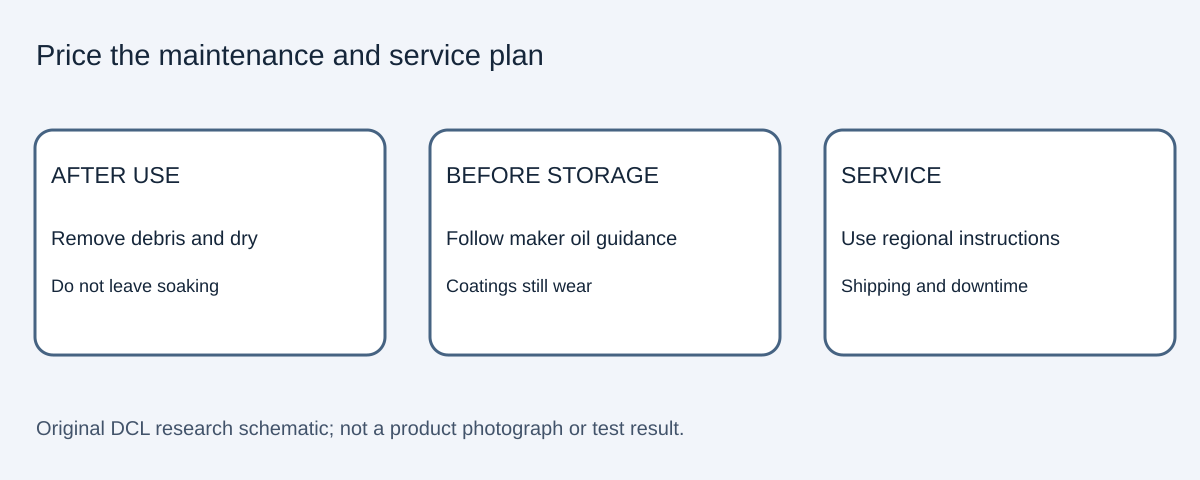
Price the maintenance and service plan before choosing
Added research checked October 31, 2026. Kershaw’s product-care instructions make ownership more concrete than a steel label: remove debris, use mild detergent if needed, dry thoroughly and do not leave the knife sitting in water. The maker calls for a light oil coating on blade and hinge before storage. It also treats coating wear and scratches as expected with use. These are care requirements, not evidence that Misdirect outlasts Mini Praxis.
| Ownership preference | What to establish | Drawback to budget |
|---|---|---|
| Maintain the knife yourself | Suitable care supplies and familiarity with the exact knife | Time and supplies beyond purchase |
| Use maker sharpening/service | Current regional process and shipment requirements | Shipping, turnaround and time without the knife |
| Keep a modified knife | Whether the maker can service its present configuration | Do not assume aftermarket parts receive factory support |
Kershaw’s current service page, marked updated March 10, 2026, requires a completed service form before mailing; missing documentation can cause return without service. It directs Canadian customers to Kershaw Canada. Check the current process before shipping, including applicable transport rules, rather than treating US service as a universal destination.
The page describes a limited warranty against manufacturing defects, not an all-damage replacement promise. Read the exclusions for wear, misuse and modifications. Delivered knife price, supplies and regional shipping totals remain unknown. A service program can be useful, but does not remove maintenance or guarantee a repair outcome. DCL has not cleaned, sharpened, dismantled or serviced either compared model. If you do not want the upkeep, an owned appropriate tool or a knife-free carry plan may fit better.
Sources and limits
This guide compares published specifications and source documentation. Daily Carry Lab has not performed hands-on tests of the products in this guide. Consult the dated sources and verify the exact model and current terms before buying.
Related guides
RFID wallets: compare protected capacity, thickness and card access
Compare Secrid Miniwallet Original Black and Ridge Royal Black by card capacity, published thickness, cash storage and documented RFID scope.
Pocket pens: choose a capped compact pen or a retractable refillable pen
Compare Fisher Chrome Bullet 400 and Zebra F-701 All Metal by closure, refill identity and carry checks. Manufacturer research, not writing or durability tests.
Keychain multitools: choose scissors, drivers and blade presence
Compare Leatherman Micra and Gerber Shard by implements, dimensions, mass and keyring tradeoffs without unsupported travel-clearance claims.
iPhone 18 Pro: Wrist Strap or Crossbody Strap, with the right case
Compare exact Apple Wrist and Crossbody strap packages for iPhone 18 Pro by attachment, length, complete cost and limitations.